
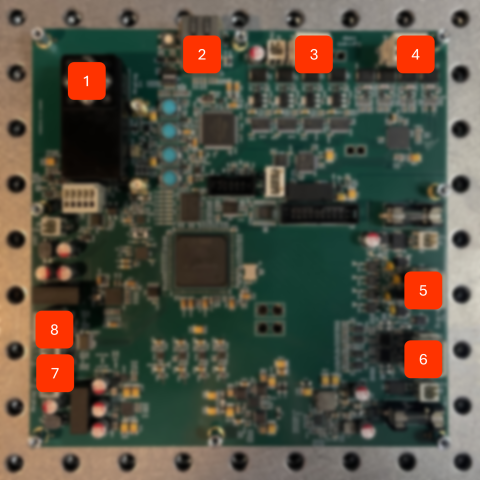
The EDa774 measurement card acquires and processes light scattering signals and offers additional functions for triggering, control, and reading and outputting external analog and digital signals.
It is used in conjunction with a TSTOF measuring probe to perform droplet or particle measurements.
Up to four measurement cards can be operated simultaneously, allowing a correspondingly high number of light scattering signals to be acquired and processed in real time. One of the measurement cards is defined as the master.
The measurement cards can be operated in SprayQuantAI© or ParticleTensorAI© mode.
A light scattering signal from the measuring probe is detected via the optical interface (1), converted into an analog signal, then digitized and processed internally.
After signal processing is complete, the final measurement data is output via the Ethernet interface (2).
This measurement data can be visualized on an HMI using the SprayQuantAI© or ParticleTensorAI© software and saved if required.
One-dimensional measurement data such as droplet size, droplet velocity, droplet count, or droplet transparency can optionally be output via the 4–20 mA current interface (3) in parallel with the main operation, averaged with a temporal resolution from 100 ms.
The resolution and bandwidth of this interface are adapted to the variables to be transmitted via software using SprayQuantAI© or ParticleTensorAI©.
Furthermore, the measurement card has an additional current interface (4) for reading external analog signals.
These read signals can be displayed in the SprayQuantAI© or ParticleTensorAI© software and saved together with the measurement data.
This enables, for example, the synchronized acquisition of external pressure, temperature, or flow sensor data.
This allows for the creation of a mapping between the droplet or particle data and the atomization parameters, which forms an important basis for AI-supported analyses.
Up to four digital signals can be output via the 24 V digital outputs (5).
These can be used, for example, to control indicator lights to display processing results in real time, or to start or stop external machines.
In addition, up to four 24 V digital inputs (6) are available, via which signals from other measurement cards or external machines can be read.
These input signals can be integrated into the processing process if required.
Interfaces (5) and (6) can also be used as quasi-triggers.
Due to galvanic isolation, the delay time is approximately 1 s.
For fast triggering (down to 4 ns), trigger interfaces 1 (7) and 2 (8) are available.
Both have one input and one output for TTL signals.
All interfaces of the measurement card are galvanically isolated.
For better protection, it is recommended to use separate power supplies with separate ground points.
Alternatively, a common power supply for all interfaces can be used.