
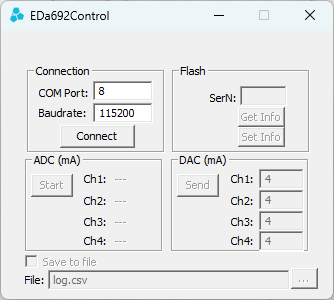
Software EDa692Control v.1.1.1.exe
The 4–20 mA current loop interface is a widely used analog communication standard in industrial measurement and control systems. It is commonly applied to transmit sensor signals such as pressure, temperature, flow rate, or level from field instruments to control units like PLCs or distributed control systems.
In a 4–20 mA loop, the measured variable is encoded as a current value: 4 mA represents the minimum measurement value, while 20 mA represents the maximum. The same current flows through all components in the loop, including the power supply, transmitter, wiring, and receiver. Because information is transmitted as current rather than voltage, the signal is largely independent of cable resistance and voltage drops.
One important feature of this interface is the use of 4 mA instead of 0 mA as the lower limit. This allows the system to distinguish between a valid zero measurement and a fault condition such as a broken wire or power loss, which typically results in 0 mA.
Advantages
The 4–20 mA interface is highly robust and reliable, even in electrically noisy industrial environments. Since the signal is based on current, it is largely immune to electromagnetic interference and voltage drops over long cable runs, making it suitable for distances of several hundred meters or more.
Another advantage is fault detection: currents below 4 mA or above 20 mA can be used to signal errors such as sensor failure or cable breaks.
The interface is also simple and standardized, allowing easy integration of sensors and control systems from different manufacturers. Additionally, many two-wire transmitters can be powered directly from the loop, reducing wiring complexity.
Disadvantages
Despite its robustness, the 4–20 mA interface has limitations. It is an analog signal, so it cannot directly transmit complex or digital information such as device status, calibration data, or multiple measured variables without additional protocols.
The measurement resolution is limited by the analog-to-digital conversion in the receiving system and by noise in the loop.
Furthermore, each measured variable requires its own current loop, which can increase wiring effort and installation cost in large systems. Compared to modern digital fieldbuses, diagnostics and configuration capabilities are relatively limited.
In summary, the 4–20 mA current loop remains a proven and reliable solution for industrial signal transmission, particularly where robustness, simplicity, and long-distance communication are required, even though it is increasingly complemented by digital communication technologies.