
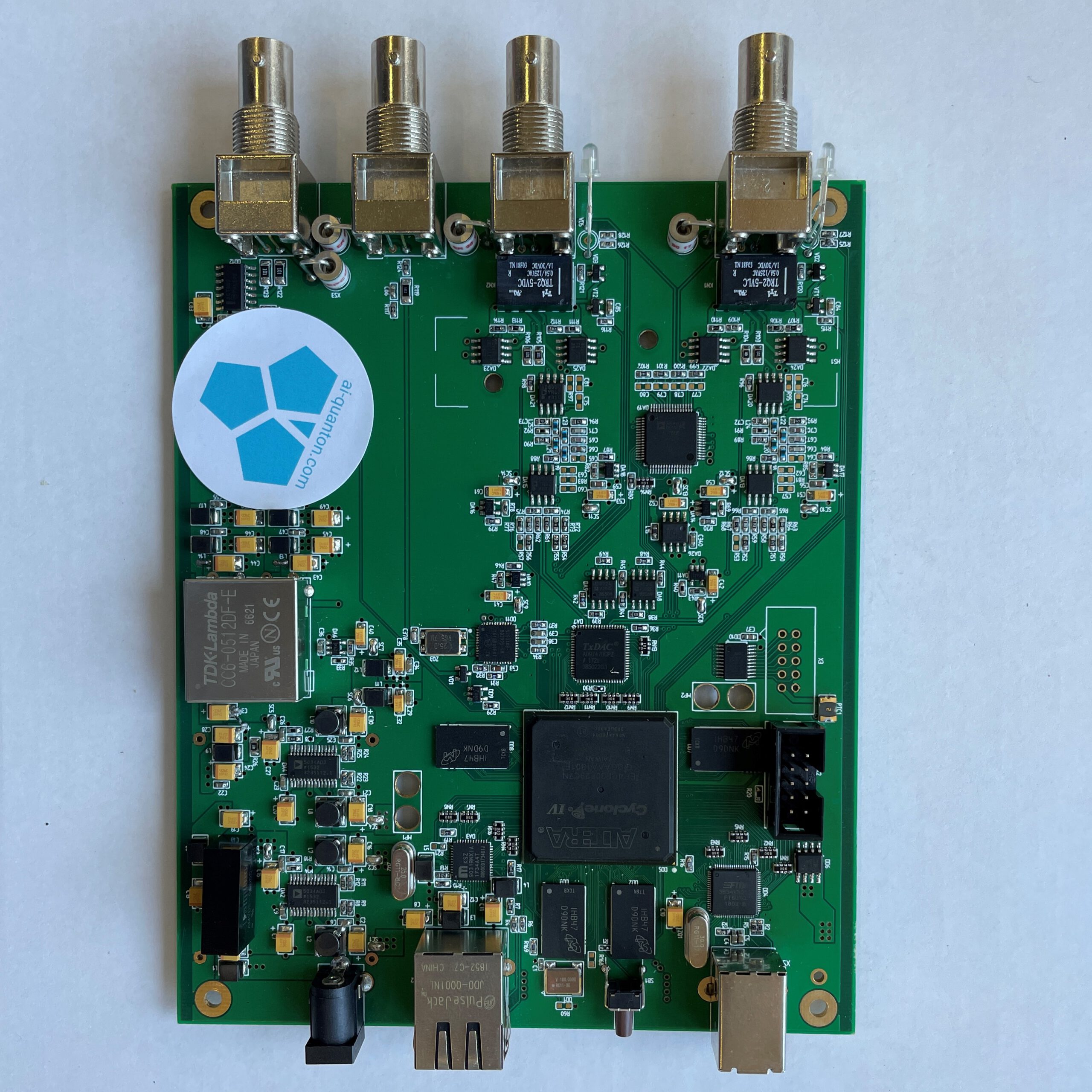
The EDa331 Arbitrary Function Generator is designed to generate a wide range of electrical signals over a frequency range from 0.1 Hz to 25 MHz with an output voltage of up to ±10 V. The device is equipped with Ethernet and USB interfaces, as well as an additional trigger input and output.
The number of output channels is 2. The output impedance of each channel is 50 ohms. The output voltage range is ±10 V and ±3 V when operating with a 1 kΩ load, and ±5 V and ±1.5 V when operating with a 50 Ω load. The DAC resolution is 16 bits.
The basic absolute DC voltage setting error is ±(0.005 + 0.001 × U), where U is the set output voltage in volts. The basic absolute AC voltage setting error when operating with a 50 Ω load is ±(0.005 + 0.01 × U) in the frequency range from 0.1 Hz to 1 MHz, and ±(0.005 + 0.025 × U) in the frequency range from 1 MHz to 25 MHz. Here, U is the RMS value of the sine-wave voltage in volts.
The maximum signal sampling rate is up to 250 MHz. The signal generation frequency range is from 0.1 Hz to 25 MHz. The absolute error in setting the signal frequency is ±(0.01 + 5 × 10⁻⁵ × f) Hz, where f is the set frequency in Hz. The short-term frequency instability after setting the operating mode does not exceed ±1 × 10⁻⁶ over 15 minutes of operation.
The generator supports single and continuous generation modes. The start source can be internal or external, with an adjustable trigger level. An output synchronization pulse with positive polarity and TTL level is provided.
The device is equipped with Ethernet (1 Gbps) and USB 3.0 computer interfaces. It operates from a 5 V power supply. The dimensions are 150 × 50 × 190 mm, and the weight is 0.7 kg.
The software is implemented for Windows 7, 8, and 10 operating systems. Automatic calibration and signal amplitude adjustment depending on the connected load are supported. The software allows generation and real-time modification of the main parameters of standard signal types including DC voltage, sine, triangle (including sawtooth), square, exponential, and noise signals.
Signal generation can be performed by setting the basic parameters of standard waveforms, analytically using mathematical formulas and a function library, or by reading previously generated or stored signals from memory, including signals recorded by digital oscilloscopes and stored in ASCII format. The software also provides on-screen simulation of the actually generated signal, taking into account the resistance of the connected load and the sampling frequency.