

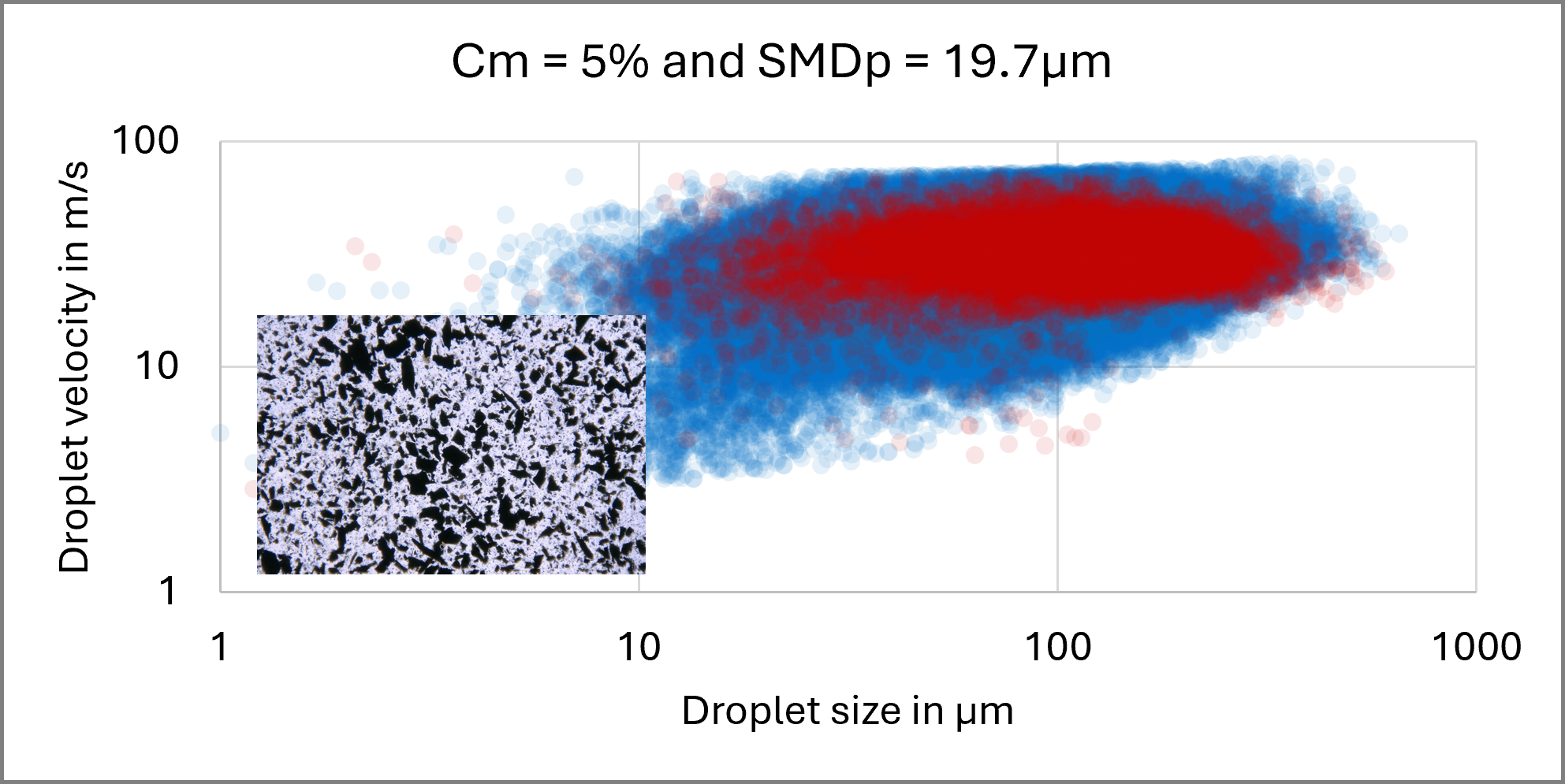
Poster presentation on Optical Monitoring of Slurry Sprays at VDI/DECHEMA 2025 in Clausthal-Zellerfeld, Germany At the Annual Meeting of the VDI / DECHEMA Expert Groups on Agglomeration & Bulk Solids Technology and Drying Technology, held at Clausthal University of Technology, W. Schaefer presented a poster on a novel optical method for the analysis of slurry sprays. This work represents an important step toward reducing CO₂ emissions in recycling processes and supports the transition to a more sustainable, circular economy.
Abstract
Reducing carbon dioxide emissions remains a critical global challenge, especially during the shift towards a circular economy. Efficient diagnostic tools are essential for analyzing the composition of heterogeneous feedstocks in recycling processes. This study introduces an optical measurement method to monitor slurry sprays, aiming to reduce emissions and enhance real-time process control.
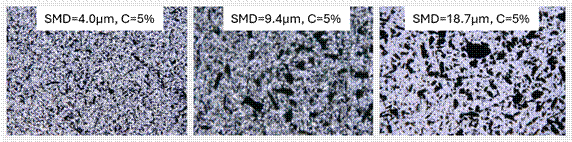
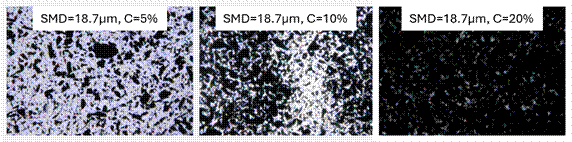
Figure 1: Microscope images of suspension used in the experiment.
The proposed method utilizes light scattering from individual suspension droplets as they pass through an elliptical Gaussian beam [1]. By analyzing the light scattering signals, it is possible to determine the variation of the particle concentration and the particle size distribution. Experimental setup employed a gas-assisted coaxial nozzle with constant operating conditions [2]. Suspensions with different weight concentrations (5%, 10%, 20%) and particle sizes (4.0 µm, 9.4 µm, 18.7 µm) were examined to establish correlations between droplet properties and composition.
A Time-Shift Time-of-Flight (TSTOF) [3] system was used to generate and analyze light scattering signals from suspension droplets. The relative number of the semi-transparent and non-transparent suspension droplets (Nrel) and the largest possible size distribution of semi-transparent droplets (SMD) were measured.
The study revealed strong correlations between SMD and Nrel and suspension concentration and particle size. Higher suspension concentrations and smaller particle sizes increased light absorption, reducing droplet semi-transparency. Results demonstrated that SMD and Nrel effectively characterize suspension composition. Semi-transparent droplet rates decreased as suspension concentration increased, showcasing the method’s capacity to distinguish particle concentration and size within the tested range.
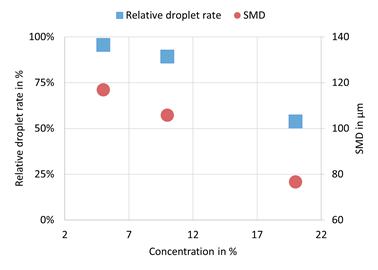
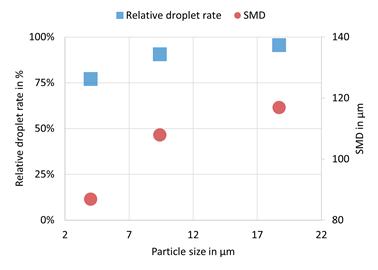
Figure 2: Correlation of relative droplet rate and droplet size by SMD (left) with suspension concentration and (right) with size by SMD of suspended particle
Building on these findings, a simplified version of the TSTOF setup is proposed, where the instrument involves a single light source and two detectors, simplifying signal processing to peak detection within a low-frequency band. This compact and cost-effective system can monitor slurry sprays, paint sprays, and other heterogeneous droplet systems.
In addition, machine learning algorithms could further optimize the system as shown in [4] by analyzing light scattering signal shapes from a single light scattering signal, a model can classify droplets as semi-transparent or non-transparent. This allows the realization of an instrument which has only one light source and one detector. This simplified configuration holds significant potential for real-time industrial monitoring of slurry sprays.
References:
[1] C. Tropea and W. Schäfer, “Verfahren und Vorrichtung zur Bestimmung der Größe eines opaken transluzenten Teilchens,” DE102012102364A1, 2012 [Online]. Available: https://patents.google.com/patent/DE102012102364A1
[2] S. Wachter, T. Jakobs, and T. Kolb, “Effect of solid particles on droplet size applying the time-shift method for spray investigation,” Appl. Sci., vol. 10, no. 21, pp. 1–17, 2020, doi: 10.3390/app10217615.
[3] W. Schaefer, C. Tropea, G. Wigger, and D. Eierhoff, “Spray measurements with the time-shift technique,” Meas. Sci. Technol., vol. 32, no. 10, p. 105202, Oct. 2021, doi: 10.1088/1361-6501/ac0467.
[4] W. Schaefer and L. Li, “Particle characterization by analyzing light scattering signals with a machine learning approach,” Appl. Opt., vol. 63, no. 29, p. 7701, Oct. 2024, doi: 10.1364/AO.531346.Welcome to WordPress. This is your first post. Edit or delete it, then start writing!