

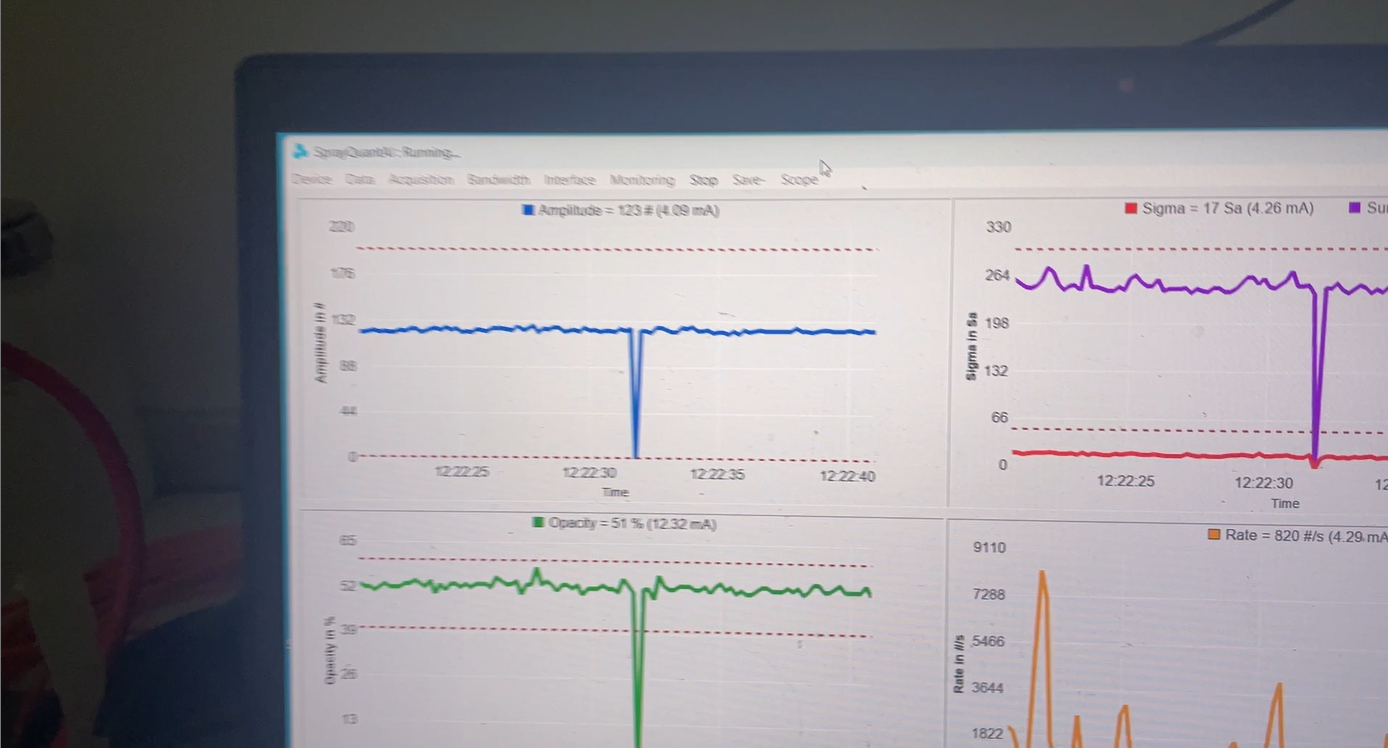
SprayQuantAI® (SQA) is an optical measurement platform for dynamic spray diagnostics, droplet characterization, and industrial spray monitoring. The system records time-resolved light-scattering signals from individual droplets or particles and converts them into quantitative information about the spray.
Depending on the measurement configuration and evaluation method, SprayQuantAI® can determine parameters such as droplet size, droplet velocity, droplet number, size and velocity distributions, and temporal changes in the spray process.
A central feature of SprayQuantAI® is the combination of an established physical measurement principle with modern signal processing. Individual particle events can be evaluated using either classical calculation methods or AI-based algorithms.
What Can SprayQuantAI® Measure?
SprayQuantAI® measures individual droplets or particles directly within the spray. Depending on the optical configuration, evaluation method, and measurement task, the available results can include:
- droplet or particle size
- droplet or particle velocity
- droplet or particle number
- particle or droplet rate
- size distributions
- velocity distributions
- temporal changes in the spray
- spray stability
- statistical process parameters
The measurement data can be used for scientific investigations, atomizer development, quality control, process optimization, and continuous industrial spray monitoring.
Measurement Principle
SprayQuantAI® is based on time-resolved optical light-scattering measurements and builds on the Time-Shift-Time-of-Flight (TSTOF) measurement concept.
An optical measurement probe generates a specifically shaped illumination field inside the measurement region. When a droplet or particle passes through this field, it scatters light toward one or more optical detectors.
Because the particle is moving, different parts of the illumination field are crossed at different times. The spatial intensity distribution of the light is therefore transformed into a characteristic time-dependent scattered-light signal.
The temporal structure of this signal contains information about the interaction between the particle, the illumination geometry, and the optical detection system.
From Spatial Information to Time Information
A central idea of the measurement concept is the conversion of spatial optical information into time information. Instead of determining particle properties only from absolute scattered-light intensity, SprayQuantAI® makes extensive use of the temporal structure of the measured signal.
This is advantageous because time can be measured with very high precision. Defined spatial structures within the optical measurement field can therefore be connected to precisely measured time intervals as the particle moves through the measurement region.
This spatial-to-temporal conversion provides the physical basis for determining particle velocity and, depending on the optical configuration and evaluation method, particle size and additional particle-related quantities.
Individual Droplet and Particle Events
SprayQuantAI® is primarily an individual-event measurement system. Each droplet or particle passing through the measurement region generates its own time-resolved light-scattering signal.
The signals are detected and evaluated individually. Results from many particle events are then combined to generate statistical information about the complete spray.
This makes it possible to investigate both individual droplets and changes in the statistical spray behavior over time.
Two Evaluation Methods
The same fundamental optical measurement principle can be combined with two different methods for extracting particle information from the recorded signals:
- Classical Evaluation based on defined physical and geometrical relationships
- AI-Based Evaluation based on trained machine-learning models
The two approaches are complementary. The appropriate method depends on the optical configuration, measurement task, available reference data, and required measurement parameters.
Classical Evaluation
Classical SprayQuantAI® evaluation determines particle properties from characteristic features of individual time-resolved light-scattering signals. The calculation uses the known optical geometry together with precisely measured time intervals within the particle signal.
Depending on the configuration, characteristic signal positions, time shifts, signal widths, amplitudes, or relationships between detector signals can be evaluated.
Particle Velocity
Particle velocity can be determined from the time required for a particle to move between defined positions within the optical measurement field.
v = Δx / Δt
The spatial distance Δx is defined by the optical geometry, while Δt is obtained from the measured time-resolved particle signal.
Particle Size
Particle size is determined from the interaction between the particle and the spatial structure of the illumination field. Once particle velocity is known, characteristic signal durations and time shifts can be transformed into spatial information.
A key advantage is that size determination is not based exclusively on absolute scattered-light intensity. Instead, the temporal structure of the signal provides important measurement information.
Event Validation
Not every optical signal necessarily represents an ideal particle passage. Classical evaluation can therefore apply plausibility criteria before an event is included in the statistical result.
Where several independent signal quantities are available, they can also be compared with each other to assess the consistency of an individual particle measurement.
Particle → Signal → Event Detection → Signal Features → Time Measurement → Physical Calculation → Particle Parameters
AI-Based Evaluation
AI-based SprayQuantAI® evaluation uses machine-learning models to determine particle properties directly from characteristic time-resolved light-scattering signals.
The underlying physics remains unchanged: a real particle interacts with a defined optical field and produces a measured waveform. Artificial intelligence provides an alternative method for extracting information from this waveform.
Using the Measured Waveform
A recorded particle signal can be represented as a sequence of measured intensity values:
[S0, S1, …, SN−1] → AI model → [d, v]
The machine-learning model can use information distributed across the waveform, including signal shape, amplitude, characteristic positions, widths, and temporal relationships.
Training with Reference Measurements
An AI model requires reliable reference values during development. For the SprayQuantAI® concept, these reference values can be generated using an established multi-detector TSTOF measurement configuration.
Several synchronized signals are recorded from the same particle event. The classical evaluation provides reference values for properties such as particle size and velocity. One selected waveform from the same event can then be linked to these reference values.
Repeating this procedure for many particles creates a training dataset consisting of experimentally measured waveforms and corresponding reference particle properties.
Multi-detector reference measurement → Reference size and velocity → Single measured waveform → AI training
Training and Measurement Are Different Stages
Training
A reference measurement configuration provides known particle properties. These values are assigned to experimentally measured light-scattering waveforms and used to train and validate the machine-learning model.
Measurement
After training and validation, the model receives newly measured light-scattering signals and predicts the required particle properties without repeating the complete reference measurement for every event.
Reducing Optical Complexity
One objective of the AI-based concept is to reduce the optical and electronic hardware required for specific particle measurements. A more complex measurement configuration can provide the reference information during model development, while a trained model can subsequently use a reduced number of measured signals.
This approach provides the technological basis for compact SprayQuantAI® configurations such as SQA1.
AI Does Not Replace the Measurement Physics
The information evaluated by the AI model originates from the physical interaction between the droplet or particle and the optical measurement system. Artificial intelligence does not generate the measurement information itself.
Instead, the AI model learns how information already contained in the measured light-scattering signal is related to known particle properties.
Optical Physics + Measured Signal + Reference Data + Machine Learning
Classical vs. AI-Based Evaluation
| Parameter | Classical Evaluation | AI-Based Evaluation |
|---|---|---|
| Calculation principle | Physical and geometrical relationships | Relationship learned from reference measurements |
| Primary input | Defined signal features and time intervals | Measured time-resolved waveform |
| Training data | Not required | Required |
| Reference basis | Optical geometry and physical model | Experimentally determined particle properties |
| Interpretation | Direct physical calculation | Model-based prediction |
| Hardware | Defined by required physical signal information | Can potentially use reduced optical configurations after training |
Neither method replaces the other. Classical evaluation is particularly useful when reliable physical relationships are available, while AI-based evaluation can learn more complex relationships or allow a reduction of the required primary measurement hardware.
SprayQuantAI® Systems
SprayQuantAI® is available in two standard configurations. They use the same general optical measurement principle but differ in the number of active detector channels and corresponding hardware.
SQA1
SQA1 is the single-channel SprayQuantAI® configuration. It combines the LSS1 optical probe with the ZEON control unit.
The compact single-channel configuration is particularly suitable for AI-based individual-event evaluation and spray monitoring with reduced optical hardware.
SQA2
SQA2 is the two-channel SprayQuantAI® configuration. It combines the LSS2 optical probe with the IMEA control unit.
The second synchronized detector channel provides additional optical information for individual particle events and supports more advanced evaluation and validation concepts.
System Comparison
Modular Measurement Hardware
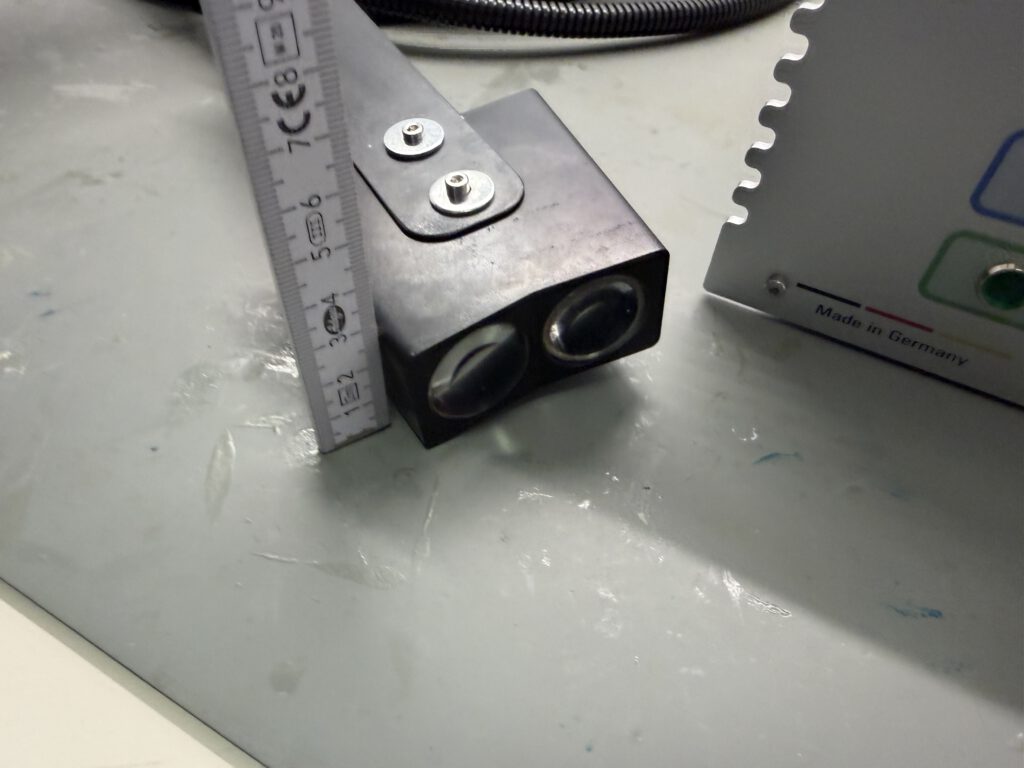
The SprayQuantAI® measurement system consists of an optical measurement probe, the corresponding control unit, and measurement and evaluation software.
The optical probe defines the measurement region and converts the interaction between droplets and the shaped illumination into time-resolved optical signals. The control unit acquires and processes these signals and provides communication with the software and surrounding process environment.
The system can be adapted at several levels, including working distance, optical geometry, detector configuration, mechanical integration, signal processing, software, and process interfaces.
Explore Optical Probes | Explore Control Units
From Droplet Measurement to Process Monitoring
SprayQuantAI® can be used not only for individual experiments but also for continuous observation of a running spray process. Individual measurements can be accumulated over defined evaluation intervals to generate continuously updated spray parameters.
Changes in droplet size, velocity, number, or statistical distributions can therefore be tracked over time and used to assess spray stability or detect deviations from a reference process.
Industrial Integration
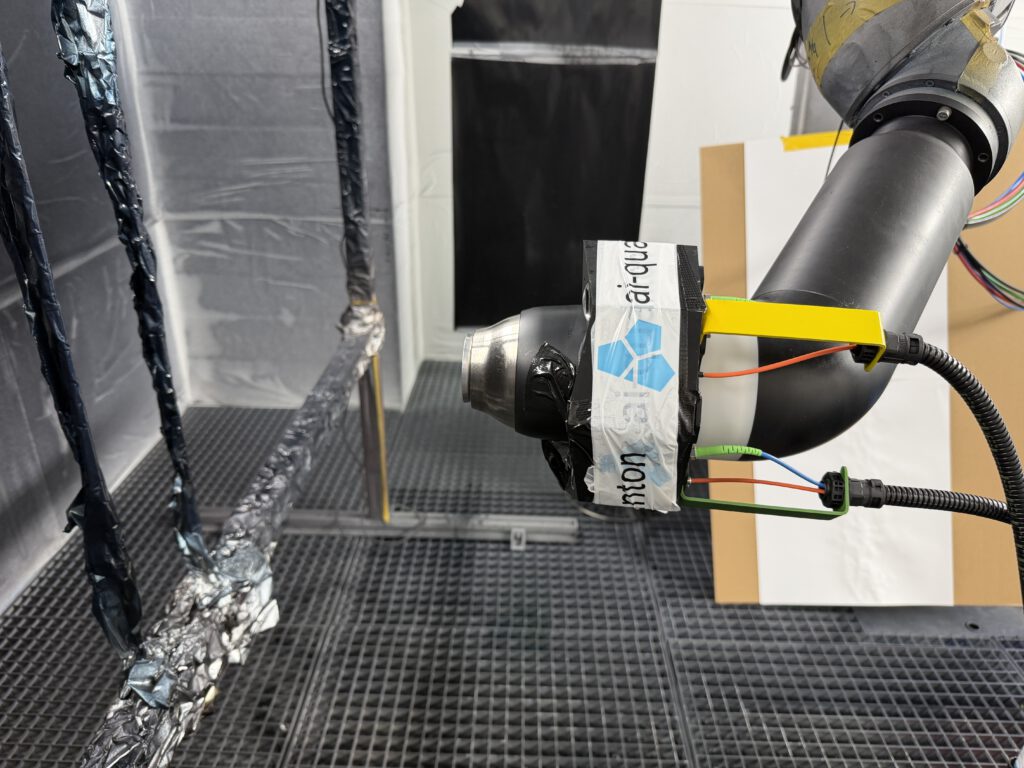
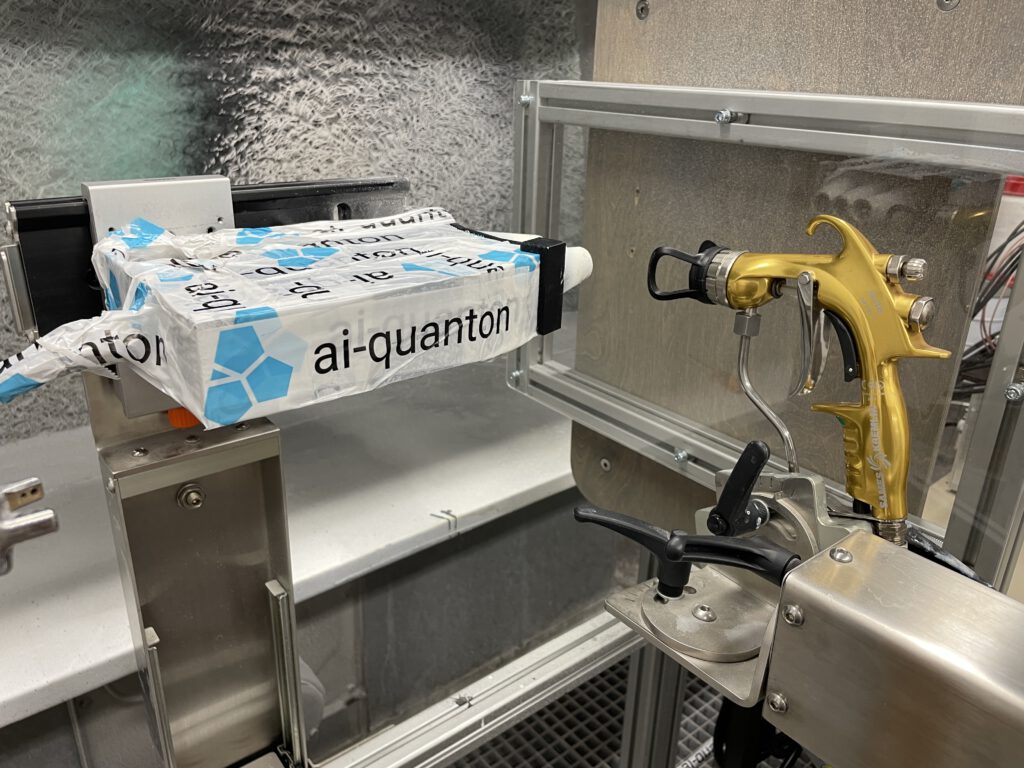
SprayQuantAI® systems can be integrated into laboratory test rigs, development systems, spray equipment, atomizers, and industrial production environments.
Depending on the control-unit configuration, interfaces can include Ethernet communication, digital inputs and outputs, analog process signals, and trigger interfaces.
Calculated measurement values can therefore be transferred to external visualization, monitoring, automation, or process-control systems.
Typical Applications
- paint and coating sprays
- spray guns
- rotary atomizers
- nozzle development
- spray process optimization
- fluid-mechanics research
- droplet and particle research
- quality assurance
- industrial spray monitoring
Application-Specific Configuration
SprayQuantAI® can be adapted to customer-specific measurement tasks. The appropriate configuration depends on the atomizer or nozzle, material, expected droplet properties, spray concentration, process conditions, installation space, and required measurement parameters.
Possible adaptations include:
- optical probe geometry
- working distance
- measurement region
- detector configuration
- mechanical integration
- laser and optical configuration
- measurement and evaluation software
- industrial data interfaces
- application-specific AI models
SprayQuantAI® and ParticleTensorAI®
SprayQuantAI® and ParticleTensorAI® can use related optical measurement hardware, but they process the recorded data differently.
SprayQuantAI® focuses on individual particle or droplet events. Classical or AI-based methods determine properties of each detected event.
ParticleTensorAI®, in contrast, retains longer buffered signal sequences and processes them as multidimensional data structures. Individual particle-event separation is therefore not always required before the AI analysis.
| Parameter | SprayQuantAI® | ParticleTensorAI® |
|---|---|---|
| Primary data unit | Individual particle event | Buffered signal sequence |
| Typical data representation | Signal features / particle properties | Multidimensional tensor |
| Evaluation | Classical or AI-based | AI-based |
| Primary focus | Quantitative droplet measurement and spray monitoring | Complex particle, material and process characterization |
Scientific Background
SprayQuantAI® builds on more than a decade of research into optical droplet and particle characterization using the Time-Shift-Time-of-Flight technique. The underlying physical measurement method has been investigated in scientific publications covering transparent and non-transparent particles, droplet size and velocity measurement, sprays, and industrial applications.
Machine-learning-based evaluation extends this concept by allowing particle properties to be determined from individual measured light-scattering waveforms using experimentally generated reference data.
Selected References
[1] Schaefer, W.; Li, L.; Stegmann, P.; Terada, M. Technical Report on the TSTOF Measurement Method: Technical Basics, Historical Development, and Comparison with Other Laser-Based Measurement Methods. Photonics 2026, 13(1), 56. https://doi.org/10.3390/photonics13010056
[2] Schaefer, W.; Li, L. Particle characterization by analyzing light scattering signals with a machine learning approach. Applied Optics 2024, 63(29), 7701–7707. https://doi.org/10.1364/AO.531346
[3] Schäfer, W. Verfahren und Vorrichtung zur Charakterisierung der Teilcheneigenschaften durch Auswertung eines Streulichtsignals mittels eines maschinellen Lernmodells und Reduzierung des primären Apparates. German Patent Application DE102023134228A1. Patent applicant: ai-quanton GmbH.
Select a SprayQuantAI® System
For an application-specific spray measurement or monitoring solution, contact ai-quanton with information about the atomizer or nozzle, material, expected droplet properties, process conditions, and required measurement parameters.
Trademark notice: SprayQuantAI® is a registered trademark.