

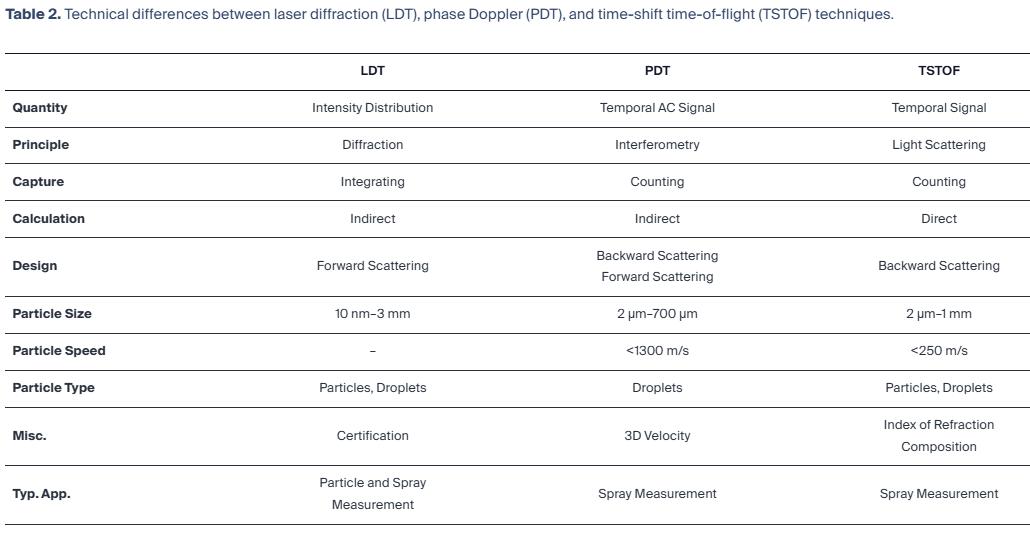
In this scientific paper [1], we discussed the decisive differences between the TSTOF measurement technique and other laser-based measurement technologies for droplet, particle, and spray characterization.
The paper shows the applicability of the TSTOF technique for measuring paint spray and sprays with similar complex fluids, such as milk, coffee, slurry, emulsions, suspensions, and particle-loaded liquids.
TSTOF is the scientific and technical basis for several advanced measurement and evaluation approaches, including SpraySpy®, SprayQuantAI®, and ParticleTensorAI®. SpraySpy® represents the classical TSTOF-based measurement system. SprayQuantAI® and ParticleTensorAI® extend the method with AI-assisted signal evaluation for modern spray measurement and process monitoring.
[1] Schaefer, W., Li, L., Stegmann, P., & Terada, M. (2026). Technical report on the TSTOF measurement method: Technical basics, historical development, and comparison with other laser-based measurement methods. Photonics, 13(1), 56. https://doi.org/10.3390/photonics13010056
What Makes TSTOF Different?
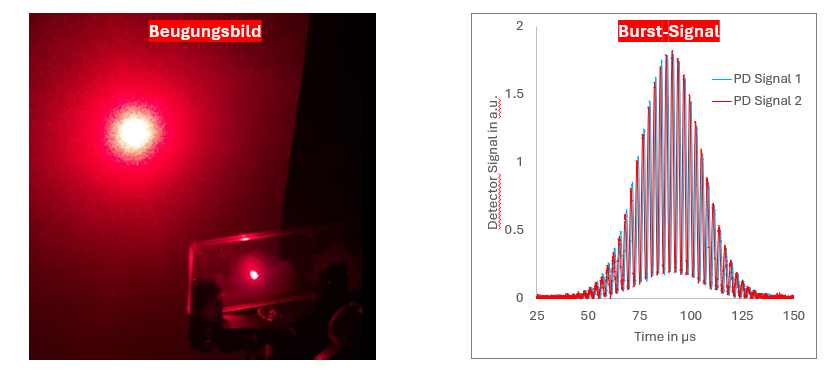
TSTOF stands for Time-Shift Time-of-Flight. The technique analyzes time-resolved light scattering signals from individual droplets or particles as they pass through a shaped light beam.
Unlike many other laser-based measurement technologies, TSTOF can also work in backscatter geometry. This means that the light source and detectors can be placed on one side of the measurement position. As a result, the method is suitable for applications with limited optical access.
This is an important advantage for industrial spray measurement. Many real processes do not allow full optical access from different sides. TSTOF can therefore support measurements in compact setups, dense sprays, coating processes, and technical spray chambers.
TSTOF for Paint Spray Characterization
A paint spray is a typical example of a complex fluid spray. Paint droplets may contain pigments, binders, additives, solvents, or suspended particles. These components influence the optical signal and can make the spray difficult to characterize with conventional methods.
TSTOF can detect individual droplets in a paint spray and analyze their time-resolved light scattering behavior. This allows the measurement of droplet size, droplet velocity, and additional signal features related to the optical and material properties of the droplets.
For coating applications, this information is highly relevant. Droplet size, velocity, transparency, and composition can influence coating quality, color tone, surface structure, and process stability.
SpraySpy®, SprayQuantAI®, and ParticleTensorAI®
SpraySpy® is the classical TSTOF-based measurement system for droplet and particle characterization. It supports optical spray measurement by evaluating light scattering signals from individual droplets or particles.
SprayQuantAI® extends the TSTOF approach with AI-assisted evaluation for spray monitoring and droplet analysis. It can support compact optical measurement setups and helps analyze complex spray processes in real time.
ParticleTensorAI® uses tensor-based AI analysis of continuous light scattering signals. This approach is especially useful for complex sprays, particle-loaded droplets, slurry sprays, and material-sensitive spray diagnostics.
Together, these technologies show how TSTOF can be used as a platform for classical and AI-assisted spray characterization.
Spray Characterization of Complex Fluids
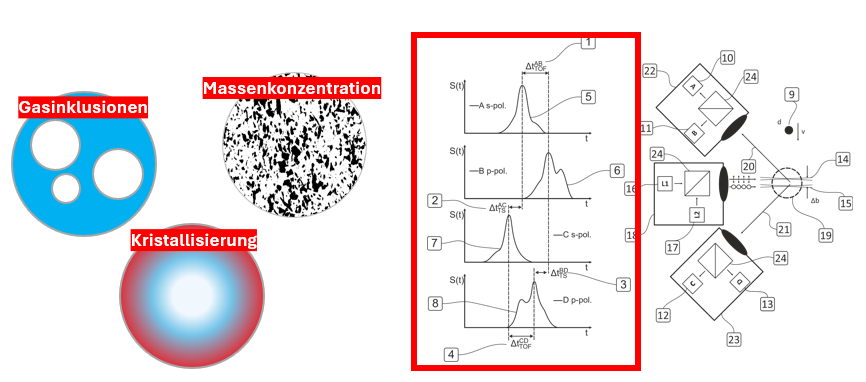
The TSTOF measurement technique can also support the characterization of other complex fluids. Milk sprays, coffee sprays, slurry sprays, emulsions, and suspensions often contain internal structures or dispersed phases. These materials can change the light scattering behavior of individual droplets.
By analyzing the complete time-resolved signal, TSTOF can provide information that goes beyond simple droplet sizing. This makes the method useful for food technology, coating technology, spray drying, pharmaceutical applications, combustion research, and industrial process monitoring.
Comparison with Other Laser-Based Measurement Methods
Classical laser-based technologies often work with forward scattering, diffraction, phase Doppler principles, or imaging. These methods are powerful, but they can face limitations when the spray is dense, opaque, highly scattering, or difficult to access optically.
TSTOF offers a complementary approach. It measures individual droplets or particles through their light scattering signals and can operate from one side of the spray. This makes the technique attractive for complex sprays and industrial measurement environments.
The method is especially relevant when users need information about single droplets or particles in a flow. It can support the analysis of transparent and non-transparent droplets, particles in sprays, and complex liquid systems.
Relevance for Industrial Spray Measurement
Modern production processes require reliable spray characterization. This includes droplet size measurement, velocity measurement, particle characterization, material analysis, and process monitoring.
TSTOF can support these tasks in laboratory and industrial environments. It helps researchers and engineers understand how process parameters influence spray behavior. These parameters may include atomization pressure, shaping air, nozzle geometry, material composition, viscosity, and concentration.
For paint spray and other complex fluids, this information can support process development, quality control, material testing, and future AI-assisted spray monitoring with SpraySpy®, SprayQuantAI®, and ParticleTensorAI®.
