

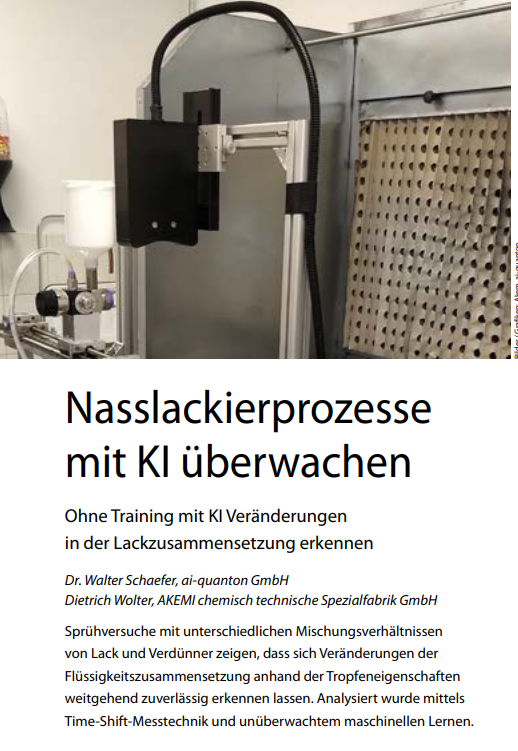
Detecting Changes in Paint Composition Directly in the Spray
We recently published a new application of artificial intelligence for paint spray monitoring and material analysis in the printed edition of mo – Magazin für Oberflächentechnik.
Together with Dietrich Wolter from AKEMI, we investigated whether changes in paint composition can be detected directly from the properties of droplets inside the spray cloud.
The central idea is to monitor not only machine parameters such as atomization pressure, air pressure, or flow rate, but the actual result of the coating process: the generated spray itself.
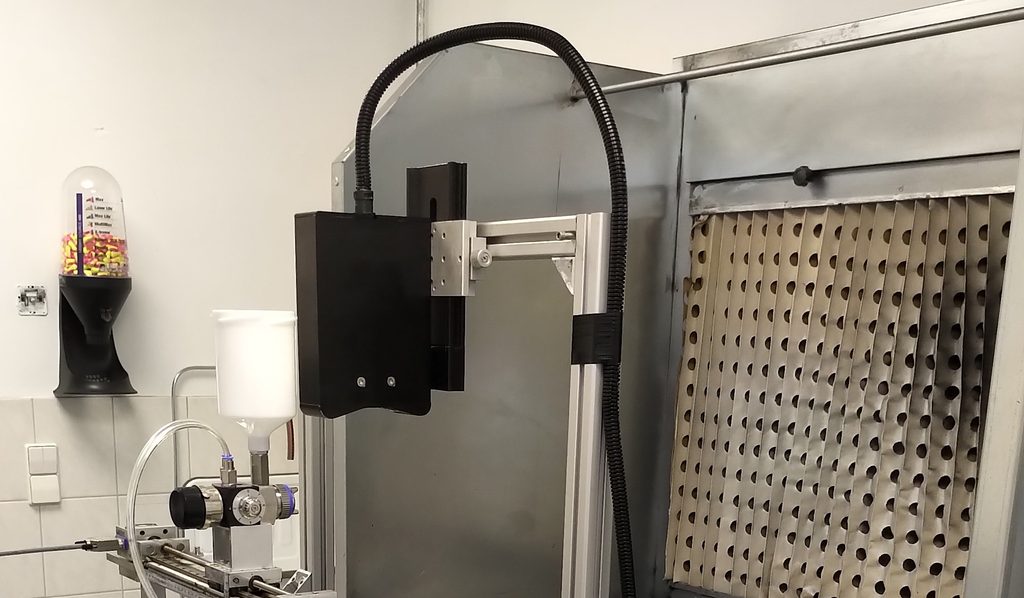
AI Paint Spray Monitoring Based on Droplet Properties
For this purpose, optical single-droplet measurements based on the Time-Shift technique are combined with unsupervised machine learning.
The measurement system records several spray and droplet characteristics, including droplet number, droplet size, droplet velocity, and optical properties. Together, these parameters form a multidimensional fingerprint of the spray.
This multidimensional approach makes it possible to detect changes that may not be visible when only a single process parameter is considered.
Unsupervised Machine Learning Without Labeled Training Data
An important advantage of the approach is that the user does not need to provide labeled training data or define application-specific thresholds in advance.
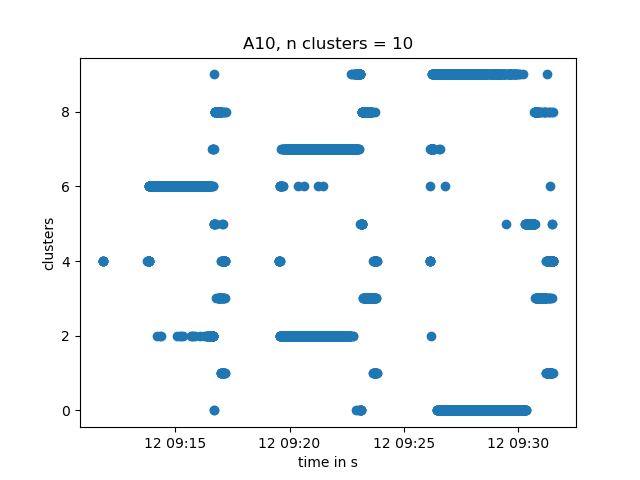
k-Means clustering is first used to automatically distinguish stable spray data from non-spray data and transient operating conditions. This is particularly relevant for continuous industrial monitoring, where measurement data may also be recorded before, between, and after actual spraying operations.
A second clustering step is then used to compare the multidimensional spray signatures of different paint compositions.
Detecting Changes in Paint and Thinner Composition
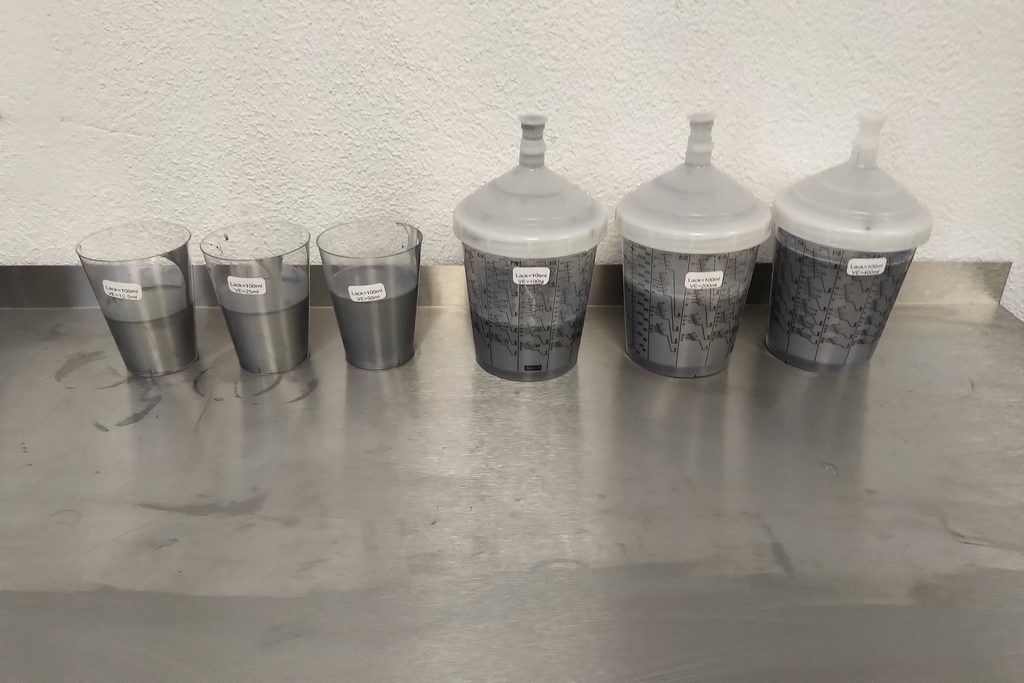
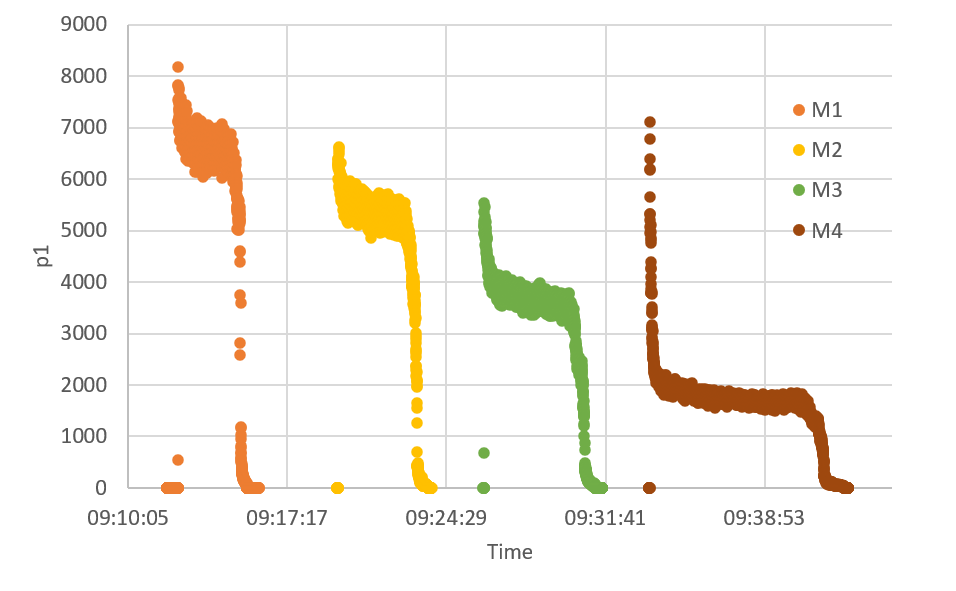
In the experiments, different mixtures of paint and thinner were investigated while the operating parameters of the atomizer and measurement system were kept constant.
The results show that 22 out of 24 comparisons between different material compositions fulfilled the defined separation criterion. This corresponds to approximately 92% of the investigated comparisons.
At the same time, repeated measurements of the same composition were not clearly separated.
These results indicate that changes in material composition can produce a measurable change in the multidimensional droplet signature.
From Machine Monitoring to Spray Process Monitoring
For industrial coating processes, this approach is particularly interesting because it evaluates the actual spray instead of relying exclusively on nominal machine settings.
Droplet number, droplet size, velocity, and optical properties are evaluated together. This makes it possible to assess process stability directly from the spray generated during the coating process.
In principle, this also allows the detection of changes that cannot be derived from the set values of the spray equipment alone.
Toward Unsupervised AI for Online Coating Process Monitoring
We see this work as an important step toward AI-based online process monitoring with minimal application-specific configuration.
The next objective is to further develop this approach toward unsupervised AI methods capable of detecting dynamic material properties and changes in paint composition directly during the spraying process.
Such methods could support continuous coating process monitoring and provide additional information about the actual state of the spray and the material being applied.
Publication
Walter Schaefer; Dietrich Wolter: “Nasslackierprozesse mit KI überwachen – Ohne Training mit KI Veränderungen in der Lackzusammensetzung erkennen.” mo Magazin für Oberflächentechnik, Vol. 80, Issue 5/2026, September/October 2026, pp. 22–26.
https://oberflaeche.de/magazin/archiv
