
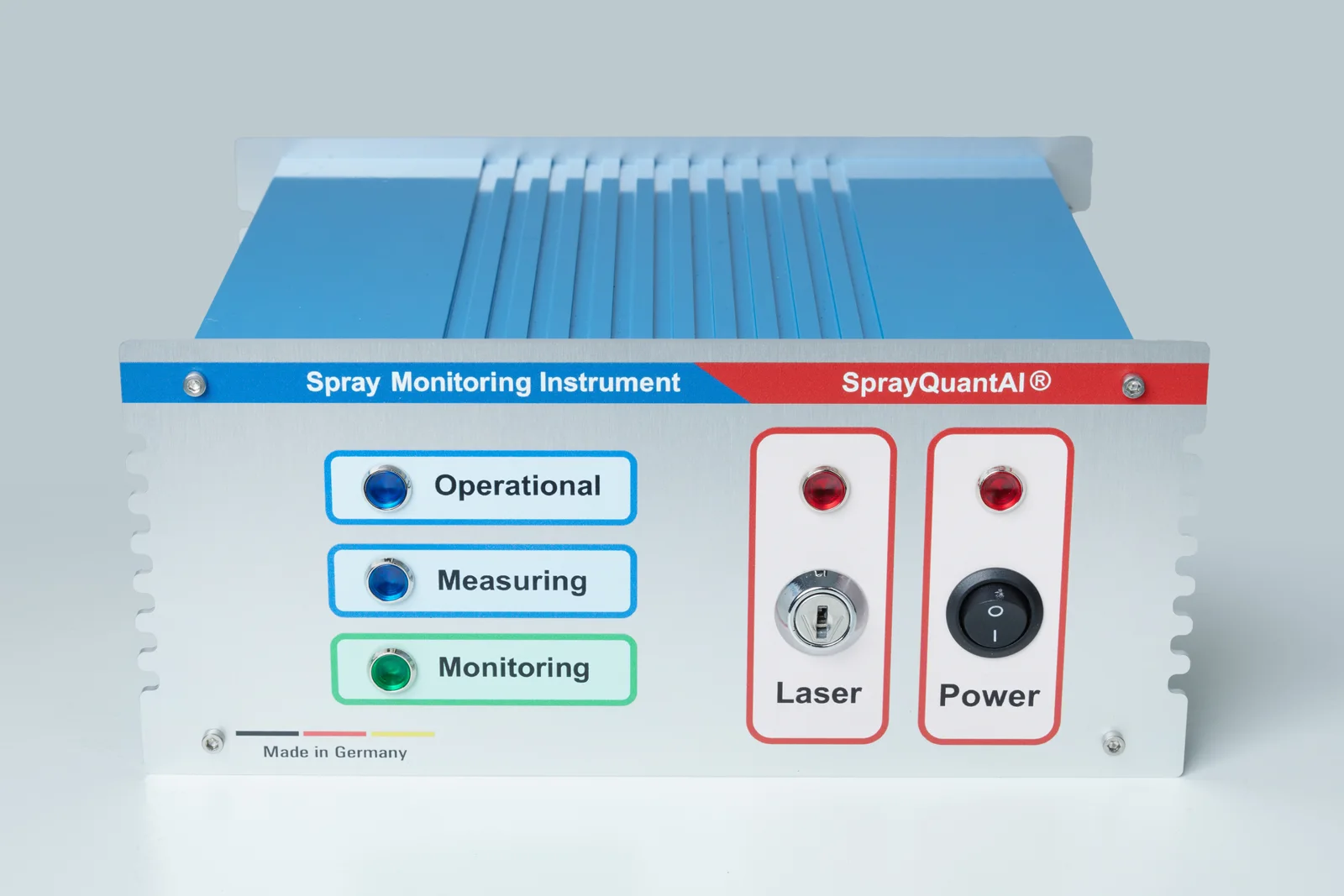
IMEA is a two-channel control unit for SprayQuantAI® and ParticleTensorAI® configurations. It performs the same general control and signal-processing function as ZEON, with a hardware configuration designed for two channels.
Two-Channel System Configuration
IMEA can be configured for either two single-channel systems or one two-channel system. The connected measurement probes and the selected software determine whether the system operates in SprayQuantAI® or ParticleTensorAI® mode.
| Operating mode | Configuration | Measurement probes | Evaluation |
|---|---|---|---|
| SprayQuantAI® | 2 × SQA1 | 2 × LSS1 | Classical or AI-based, depending on configuration |
| SprayQuantAI® | 1 × SQA2 | 1 × LSS2 | Classical or AI-based, depending on configuration |
| ParticleTensorAI® | 2 × PTA1 | 2 × LSS1 | AI-based only |
| ParticleTensorAI® | 1 × PTA2 | 1 × LSS2 | AI-based only |
These are alternative system configurations. The selected operating mode determines the electronics configuration and the associated signal evaluation.
IMEA with SprayQuantAI®
In a SprayQuantAI® configuration, IMEA can connect two SQA1 systems, each using an LSS1 probe, or one SQA2 system using an LSS2 probe. The two-channel design supports these configurations within one control unit.
SprayQuantAI® signals can be evaluated using classical or AI-based methods, depending on the selected system configuration, calibration and software.
IMEA with ParticleTensorAI®
IMEA can also be configured for ParticleTensorAI®. In this mode, the corresponding configurations are two PTA1 systems with LSS1 probes or one PTA2 system with an LSS2 probe.
ParticleTensorAI® uses AI-based signal evaluation. The IMEA electronics must therefore be configured for the selected PTA system and its data-processing method.
Function of the Control Unit
IMEA connects the optical measurement probes to the system electronics and software. It acquires the detector signals and provides the processing platform for the selected SprayQuantAI® or ParticleTensorAI® configuration.
The available functions depend on the selected operating mode, connected probes and configured software. The complete system configuration should therefore be specified for the intended measurement task.