

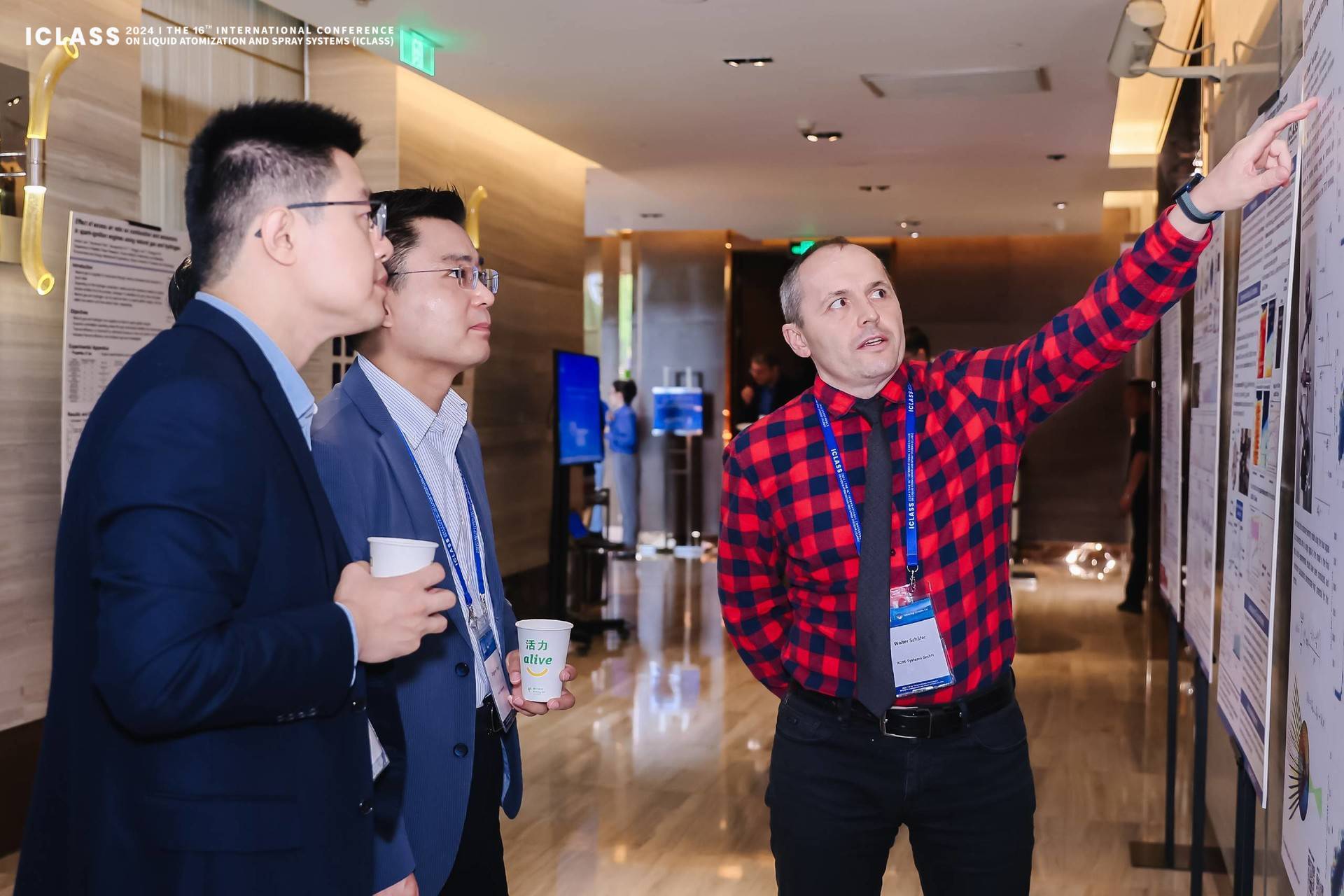
Presentation at the 16th Triennial International Conference on Liquid Atomization and Spray Systems (ICLASS 2024), Shanghai, China.
At the 16th Triennial International Conference on Liquid Atomization and Spray Systems (ICLASS 2024), held from June 23–27, 2024, in Shanghai, China, a poster was presented on particle characterization through the analysis of light-scattering signals using a machine-learning approach. The work demonstrates how data-driven methods can enhance spray diagnostics and particle analysis in complex atomization processes.
Abstract
We present here a new instrument, to our knowledge, in combination with a machine learning approach to achieve a more cost-effective and compact measurement instrument for particle characterization in a flow based on the established measurement technique known as the time-shift-time-of-flight (TSTOF) technique. A commercial device based on TSTOF was introduced and has since been recognized under the brand name SpraySpy. In this study, we propose a machine learning model capable of using only a single signal in this device to determine the same information about particles such as particle size and particle velocity, traditionally obtained from the classical measurement device based on the TSTOF technique, where four signals have been used. To achieve this, we train a machine learning model using the four signals, but connect only a single signal to the model in the final step. The initial experimental results have been conducted, and preliminary calculations demonstrate high potential for this method. By applying this method, one light source and three detectors, along with the corresponding electronics and optics, can be eliminated from a TSTOF measurement instrument. This not only reduces hardware costs but also enables the production of a smaller measurement probe and the use of a single signal acquisition system without the need for synchronization.
References:
Schaefer, W., & Li, L. (2024). Particle characterization by analyzing light scattering signals with a machine learning approach. Applied Optics, 63(29), 7701–7707. https://doi.org/10.1364/AO.531346