

DE102023127552A1
Abstract
The inventive depth of the method presented here lies in the active modification of a time-dependent signal so that it can be used to characterize a particle. The so-called oscillating signal offers advantages in signal evaluation because the frequency of the high-frequency component can be specified. This improves the selection of the signal in a continuous signal flow. The low-frequency component of the oscillating signal results from its limited edges and can be used to determine the particle property vector by analyzing the amplitude and signal smearing. Furthermore, the combinatorial complexity of the oscillating signals offers an opportunity for precise particle classification using artificial intelligence.
Claims
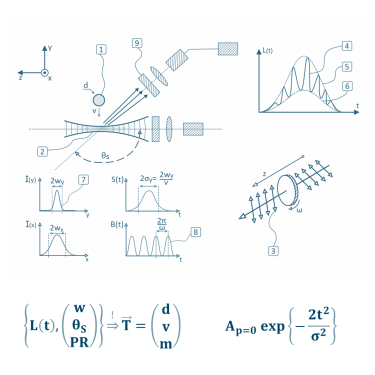
Method for generating oscillating scattered light intensities for determining a particle property vector, characterized by measuring the scattered light intensity of a particle (1) moving at a specific speed v through a shaped light beam (2) whose linear polarization direction is rotated at a predetermined angular velocity ω. At a scattering angle θ S , at which the scattered light intensity exhibits a significant polarization dependence, a temporally oscillating signal L(t) (4) is recorded. The low-frequency components (5) and (6) of this signal resemble the spatial intensity profile of the shaped light beam (7), while the high-frequency component provides information about the angular velocity (8). Procedure according to Claim 1 , characterized in that by means of a polarizer (9) in front of the radiation detector, which serves to measure the scattered light intensity, the ratio between two polarizations can be adjusted in order to vary the oscillation amplitudes in the temporally oscillating signal L(t) (4) and thus to optimize the signal quality. Procedure according to Claim 1 , characterized in that instead of rotating the polarization direction of the shaped light beam, the polarization direction of the scattered light intensity is rotated in front of the radiation detector. The polarization direction of the shaped light beam is constant and preferably at π/4 relative to the scattering plane. Procedure according to Claim 1 , characterized in that the scattering angle is preferably in the first and second Brewster angles. Procedure according to Claim 1 , characterized in that the amplitude difference of the low-frequency components (5) and (6) in the oscillating signal is used to determine the optical particle properties. Procedure according to Claim 1 , characterized in that the signal smearing of the low-frequency component (5) or (6) in the oscillating signal is used to determine the particle size d. Procedure according to Claim 1 , characterized in that the oscillating signal L(t) (4) is associated with the particle vector by means of machine learning or artificial intelligence which enables precise particle classification.