

This work was presented at the Jahrestreffen der DECHEMA/VDI-Fachgruppen Mehrphasenströmungen, Agglomerations- und Schüttguttechnik und Computational Fluid Dynamics. The conference took place at TU Dresden, Germany, from March 16 to 18, 2026. It focused on multiphase flows, agglomeration and bulk solids technology, computational fluid dynamics, new measurement methods, and AI methods for multiphase flow analysis.
https://tu-dresden.de/ing/maschinenwesen/ifvu/tpg/forschung/workshop
The presented poster focuses on the characterization of an ammonia spray and the light scattering behavior of individual LNH3 droplets. Liquid ammonia is an important future fuel candidate. However, LNH3 sprays create special measurement challenges because flash-boiling atomization can produce dense sprays, strong light attenuation, multiple scattering, and droplets with internal vapor bubbles.
Optical Challenges in LNH3 Spray Diagnostics
Optical droplet measurement in dense sprays is difficult. Many established techniques rely on forward scattering. These methods include laser diffraction, phase Doppler techniques, and imaging methods. However, dense ammonia spray conditions can limit their use.
Strong absorption inside the spray, multiple scattering, and limited optical access can disturb the light signals. As a result, forward-scattering-based techniques may lose important information or become difficult to apply.
These challenges become especially relevant for flash-boiling LNH3 sprays. Under these conditions, the liquid becomes thermodynamically unstable. In addition to primary jet breakup, internal vapor bubbles can grow inside the droplets. These bubbles may cause droplets to expand and burst.
TSTOF Measurement for Ammonia Spray Analysis
To overcome these limitations, the work uses a backscatter-based TSTOF measurement method. TSTOF stands for Time-Shift Time-of-Flight. The method records light scattering signals from individual droplets and can operate with optical access from one side.
In the presented study, a TSTOF-based measurement instrument was used to characterize an LNH3 spray under different operating conditions. The instrument records four light scattering signals for each droplet. From these signals, droplet velocity and droplet size can be determined redundantly.
This approach is especially useful for ammonia spray diagnostics because the detected signal can contain information about the internal droplet structure. This is important when LNH3 droplets contain vapor bubbles or gas inclusions.
Combination with High-Speed Imaging
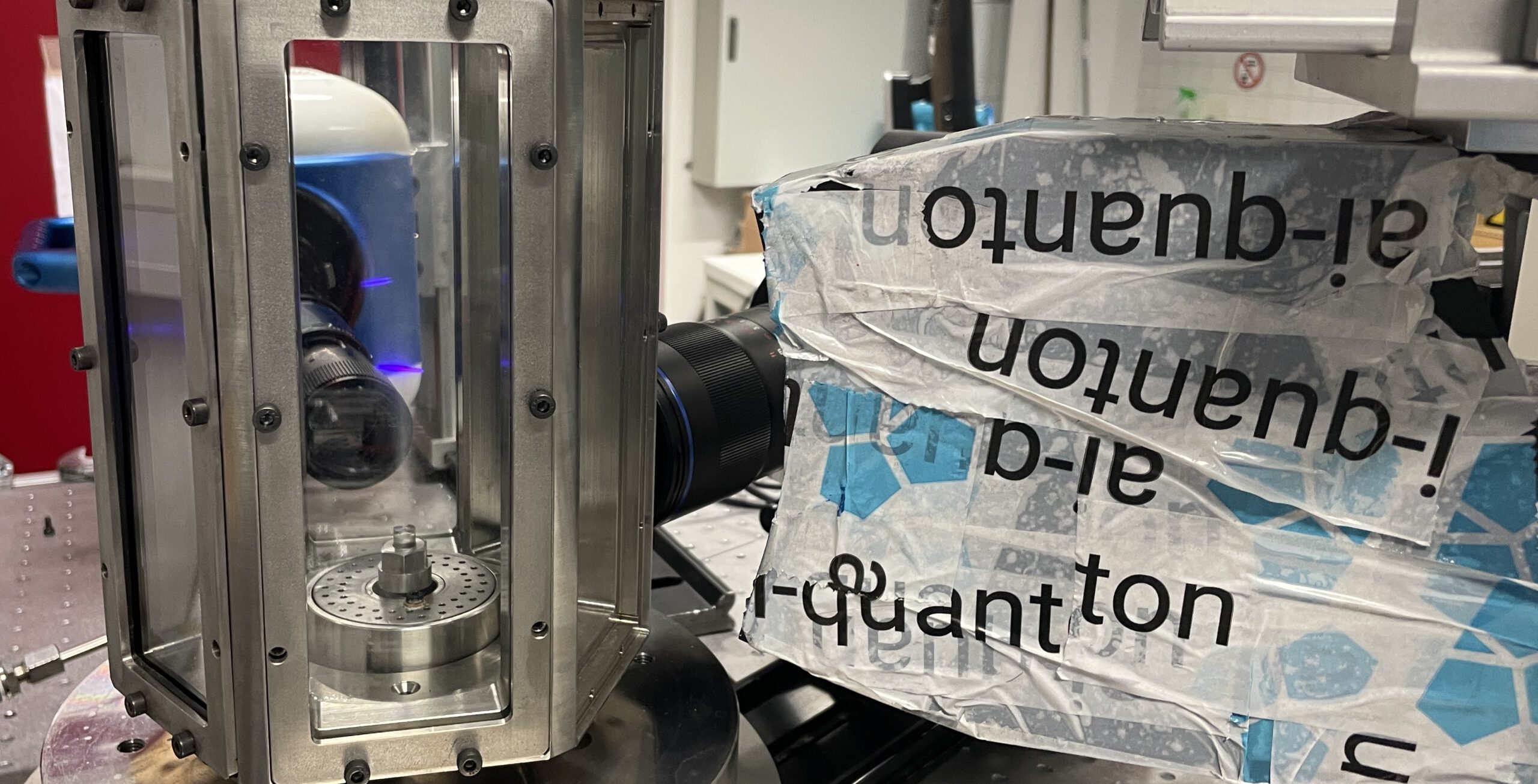
The experimental setup included a combustion chamber, a TSTOF measurement probe, and ultra-high-speed camera imaging. This combination allowed the researchers to compare optical droplet measurement with visual observations of the spray and droplet chain.
The poster also shows an LNH3 droplet chain with growing vapor bubbles. Several burst droplets are visible. These observations help explain the complex light scattering behavior of LNH3 droplets under flash-boiling conditions.
Relevance for Multiphase Flow and Future Fuel Research
Ammonia spray characterization is important for fuel research, combustion studies, multiphase flow diagnostics, and the development of new optical measurement methods. LNH3 sprays are complex because they combine atomization, evaporation, bubble growth, droplet breakup, and strong optical effects.
The presented work shows how TSTOF-based backscatter measurement can support the investigation of these processes. It provides a path toward more reliable droplet characterization in dense sprays with limited optical access.
Application Potential
This approach can support research on ammonia combustion, alternative fuels, spray atomization, dense spray diagnostics, and industrial process monitoring. It also contributes to the development of optical measurement systems for complex sprays where classical forward-scattering methods face limitations.
By analyzing the light scattering of individual LNH3 droplets, the method creates new possibilities for understanding ammonia spray behavior, internal bubble formation, and droplet breakup under flash-boiling conditions.
