

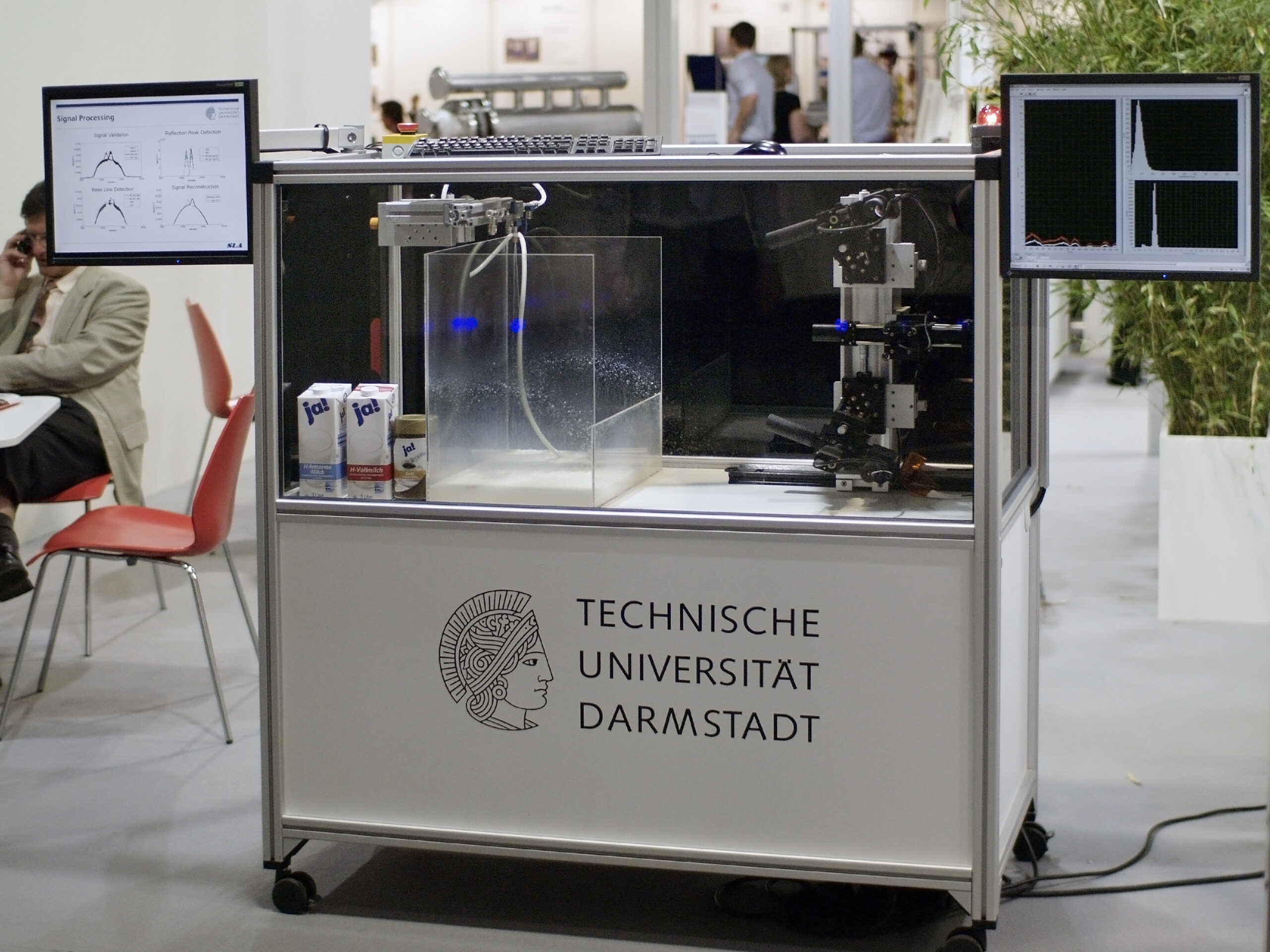
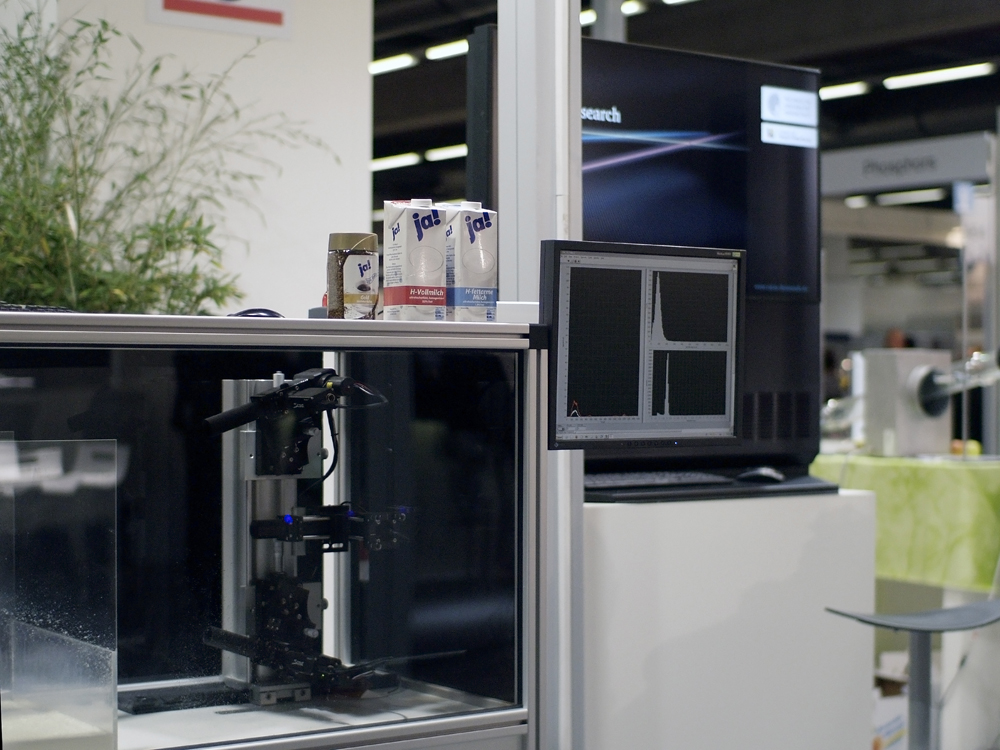
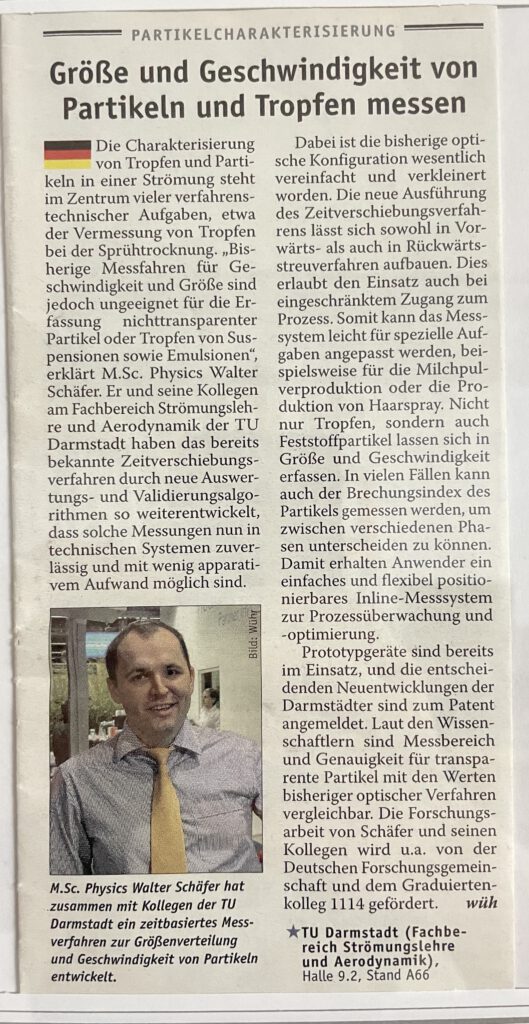
At ACHEMA 2012 in Frankfurt am Main, researchers from the Technical University of Darmstadt presented a new optical method for measuring the size and velocity of individual droplets and particles in a flow. The measurement technology was demonstrated from 18 to 22 June 2012 in Hall 9.2, Stand A66.
The exhibition marked the first public presentation of an operational measurement instrument based on the Time-Shift Time-of-Flight technique, abbreviated as TSTOF. The early prototypes emerged from Walter Schäfer’s doctoral research at the Institute of Fluid Mechanics and Aerodynamics at TU Darmstadt together with Prof. Cameron Tropea. The research later formed an important technological foundation for the development of ai-quanton and subsequent optical spray measurement systems.
About ACHEMA 2012
ACHEMA is an international exhibition and congress for chemical engineering, process technology, biotechnology, laboratory equipment, instrumentation, automation, and industrial production technology. It connects researchers, equipment manufacturers, engineers, plant operators, and industrial decision-makers.
The 30th ACHEMA took place at Messe Frankfurt from 18 to 22 June 2012. During the five-day event, approximately 167,000 participants visited the exhibits of 3,773 companies and research organizations from 56 countries. The exhibitors occupied around 136,400 square metres of exhibition space. (DECHEMA)
The event presented technologies ranging from laboratory instruments and analytical equipment to complete industrial plants, process automation, pumps, packaging systems, and safety technology. Energy efficiency and the bioeconomy were among the important themes of the 2012 exhibition.
ACHEMA has always combined an industrial trade fair with a scientific congress. Therefore, it provides a suitable platform for transferring new measurement methods from university research into practical industrial applications. The official historical review also highlights the importance of interactive and hands-on exhibits at ACHEMA 2012.
A New Method for Measuring Individual Droplets and Particles
The measurement instrument presented by TU Darmstadt addressed a central problem in spray and particle diagnostics: the reliable measurement of individual particles that are not fully transparent.
Many established optical instruments work well with clear and homogeneous droplets. However, they may produce unreliable results when the measured droplets contain:
- solid particles,
- pigments,
- emulsified materials,
- suspended particles,
- strongly absorbing components,
- several different phases.
The research team extended the time-shift approach so that it could also evaluate light-scattering signals from non-transparent particles and droplets containing suspensions or emulsions.
What Is TSTOF Measurement Technology?
TSTOF stands for Time-Shift Time-of-Flight. It is an optical measurement principle for the characterization of individual droplets or particles moving through a defined measurement volume.
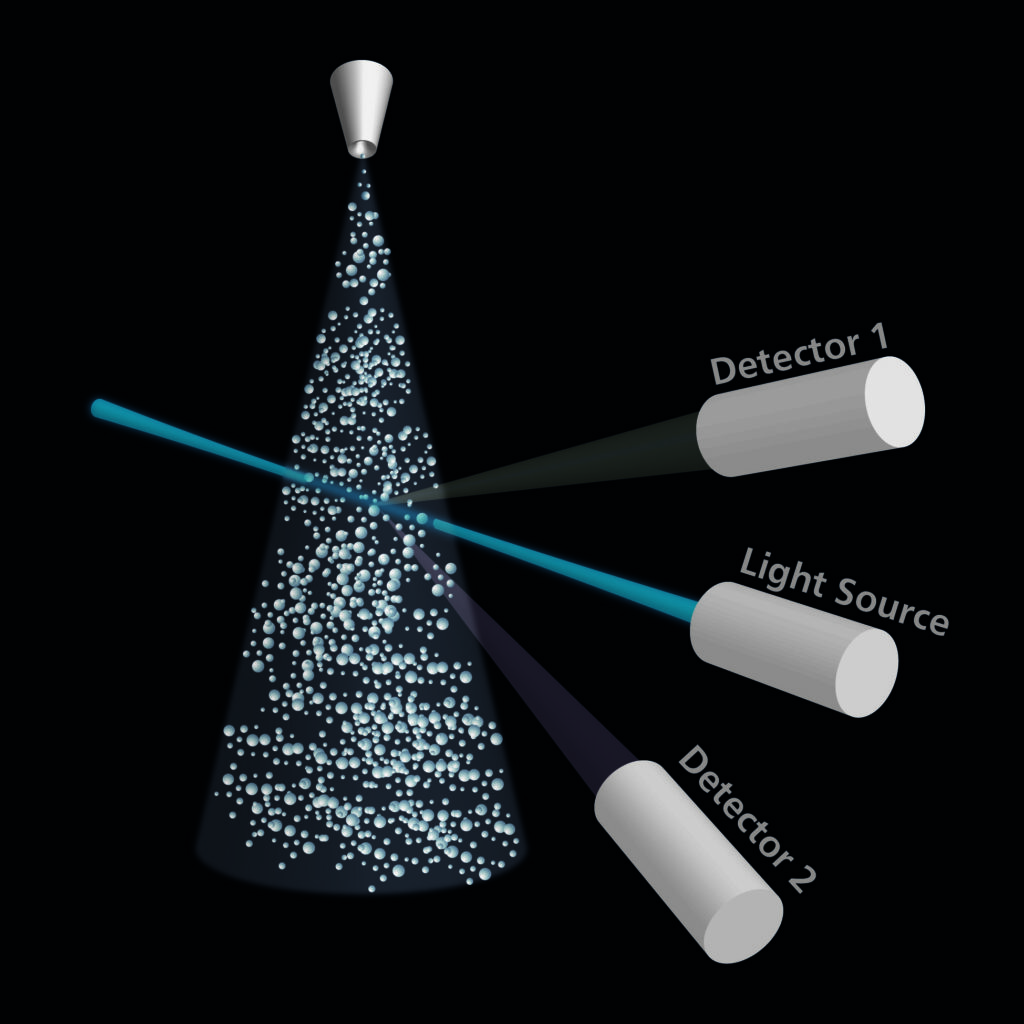
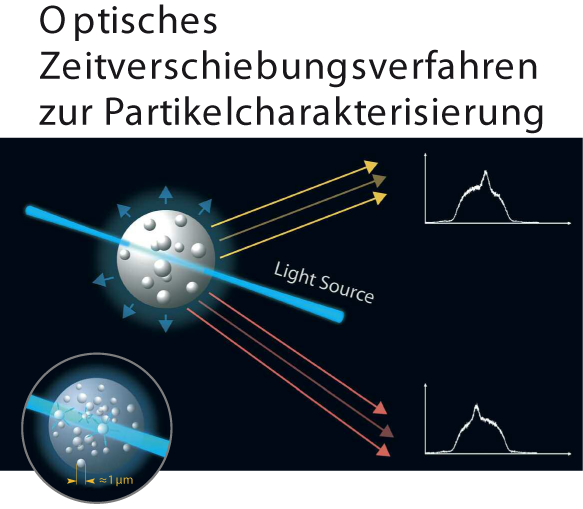
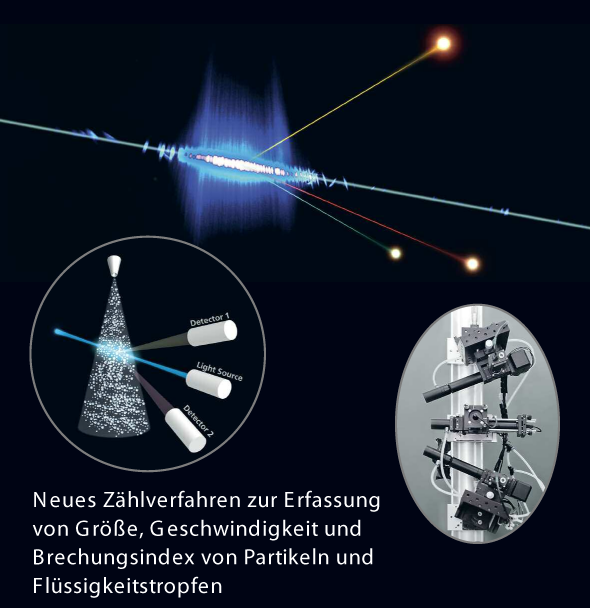
A focused light sheet with a specific spatial intensity profile illuminates the measurement area. When a droplet passes through the light sheet, it scatters light toward one or more optical detectors.
The detectors record the changing light intensity as a time-resolved signal. The position, sequence, width, and shape of the signal features contain information about the droplet and its movement.
Depending on the optical configuration and evaluation method, the system can determine parameters such as:
- particle or droplet size,
- particle or droplet velocity,
- size distribution,
- velocity distribution,
- droplet rate,
- optical properties of the droplet,
- refractive index.
The method analyzes individual particle events. Therefore, it can provide statistical distributions while retaining information about each detected droplet.
How Are Size and Velocity Determined?
The shaped illumination creates characteristic peaks within the recorded light-scattering signal.
The time required for a droplet to cross defined regions of the light sheet provides information about its velocity. At the same time, the temporal distance between characteristic scattering features can provide information about the particle or droplet diameter.
Because the system evaluates the time-dependent signal rather than only a single intensity value, it can use more of the available optical information.
This approach also creates a basis for further statistical analysis and modern machine-learning methods. However, at ACHEMA 2012, the focus was on the physical interpretation of the light-scattering signals and the practical implementation of the measurement instrument.
Measurement of Non-Transparent Droplets
One important feature of the presented development was its ability to process signals from optically complex particles.
Suspensions contain solid material dispersed in a liquid. Emulsions contain two or more liquid phases that do not fully mix. Paint droplets may contain pigments, binders, solvents, and other components.
These materials change how light travels through and scatters from a droplet. As a result, the signals can differ significantly from those generated by clear water droplets.
The new method used the recorded signal characteristics to obtain reliable size and velocity information even when the particles or droplets were not fully transparent. This extended the possible range of industrial applications.
Forward-Scattering and Backscattering Configurations
The optical system could operate in either a forward-scattering or a backscattering configuration.
In a forward-scattering setup, the detectors observe light that travels mainly through or around the particle in the original direction of the laser beam.
A backscattering setup detects light scattered back toward the side from which the illumination originates. This configuration can offer an important practical advantage because the illumination and detection components can operate from approximately the same side of the process.
Therefore, the measurement probe can adapt to different installation conditions, including systems with limited optical access. The ability to choose between forward and backscattering configurations supported the use of the technology in laboratory experiments as well as industrial environments.
Compact Instrument Design
The research developments also enabled a more compact implementation of the instrument.
A smaller measurement system can offer several advantages:
- easier installation in existing test rigs,
- reduced alignment effort,
- lower hardware costs,
- shorter optical paths,
- flexible positioning near a spray,
- better suitability for industrial measurements.
The ACHEMA presentation showed that advanced optical droplet analysis did not necessarily require a large and highly complex laboratory installation. According to the original event description, the compact configuration also aimed to reduce the required investment costs.
Refractive-Index Measurement
The research team also investigated whether the instrument could determine the relative refractive index of individual droplets or particles.
The refractive index describes how light propagates through a material. It influences the position and intensity of characteristic scattering features. Therefore, refractive-index information can help distinguish between different materials or phases.
The use of two detectors provides redundant optical information. This additional information can support an estimation of the refractive index when the particle size and velocity are also considered.
One potential application mentioned in the early research was the distinction between water droplets and ice crystals under mixed icing conditions. Both may occur simultaneously in atmospheric or aerodynamic experiments, but their optical properties differ.
Applications in Spray Drying
Spray drying converts a liquid feed into dry particles by atomizing it into a stream of heated gas.
Droplet size and velocity affect:
- drying time,
- evaporation rate,
- final particle size,
- product moisture,
- residence time,
- agglomeration,
- process efficiency.
In addition, spray-drying feeds often consist of emulsions or suspensions. Therefore, a measurement method capable of analyzing complex droplets offers clear advantages for process development and monitoring.
The ACHEMA 2012 presentation identified spray drying as one of the main industrial application areas for the new measurement technology.
Applications in Spray Painting
In painting and coating processes, droplet size and velocity influence the way the coating material reaches and interacts with a surface.
Relevant effects include:
- transfer efficiency,
- overspray,
- coating uniformity,
- surface quality,
- film formation,
- edge coverage,
- material consumption.
Paint droplets are often difficult to measure because pigments and other components absorb and scatter light. The ability to evaluate non-transparent and heterogeneous droplets therefore opened new possibilities for the optical characterization of real paint sprays.
Applications in the Food Industry
Many products in the food industry consist of emulsions or suspensions. Examples include milk, cream, flavour emulsions, liquid concentrates, and particle-containing mixtures.
During atomization, the properties of individual droplets can influence drying, coating, encapsulation, mixing, and final product quality.
The technology presented at ACHEMA 2012 aimed to measure such droplets without requiring them to behave like ideal transparent liquids. Therefore, the food industry represented another potential field of application.
Importance for Industrial Process Monitoring
The ACHEMA presentation demonstrated how an optical measurement principle developed in university research could move toward an industrial instrument.
The main benefits included:
- non-contact measurement,
- simultaneous size and velocity analysis,
- detection of individual droplets,
- suitability for non-transparent materials,
- forward- and backscattering configurations,
- compact instrument design,
- potential refractive-index estimation,
- adaptable optical and electronic components.
These characteristics made the technology relevant not only for scientific experiments but also for process development, quality control, and industrial monitoring.
From the First Prototype to Later Measurement Technologies
The first prototype emerged during doctoral research conducted between 2008 and 2012. Its presentation at ACHEMA 2012 introduced the TSTOF approach to a large international audience from the process industry.
In 2013, ai-quanton was founded as a spin-off from TU Darmstadt. Further research and development led to new instruments, signal-processing methods, patents, and AI-assisted analysis approaches.
Later systems combined the TSTOF measurement principle with:
- improved optical probes,
- compact electronics,
- faster data acquisition,
- automated signal analysis,
- statistical evaluation,
- machine-learning models.
The physical measurement process remains based on the detection of time-resolved light-scattering signals. Product and technology names used today describe later developments and should not be confused with the underlying optical principle.
Historical Importance of ACHEMA 2012
ACHEMA 2012 represented an important transition point between academic research and industrial application.
The event allowed the researchers to demonstrate that the new measurement approach could analyze more than ideal transparent droplets. It could also address suspensions, emulsions, pigmented materials, and other optically complex particle systems.
Presenting the prototype at one of the world’s largest process-industry events provided direct contact with potential users from spray drying, coating technology, food production, chemical engineering, and process measurement.
Therefore, ACHEMA 2012 became an early milestone in the history of TSTOF measurement technology and the later development of ai-quanton.
