

Walter Schäfer, and Cameron Tropea. “Characterization of Atomization Processes in Suspension/Emulsion Sprays.” Journal of Energy and Power Engineering, vol. 10, no. 4, Apr. 2016, https://doi.org/10.17265/1934-8975/2016.04.002.
Milk Spray Atomization Study Using TSTOF and AI-Based Diagnostics
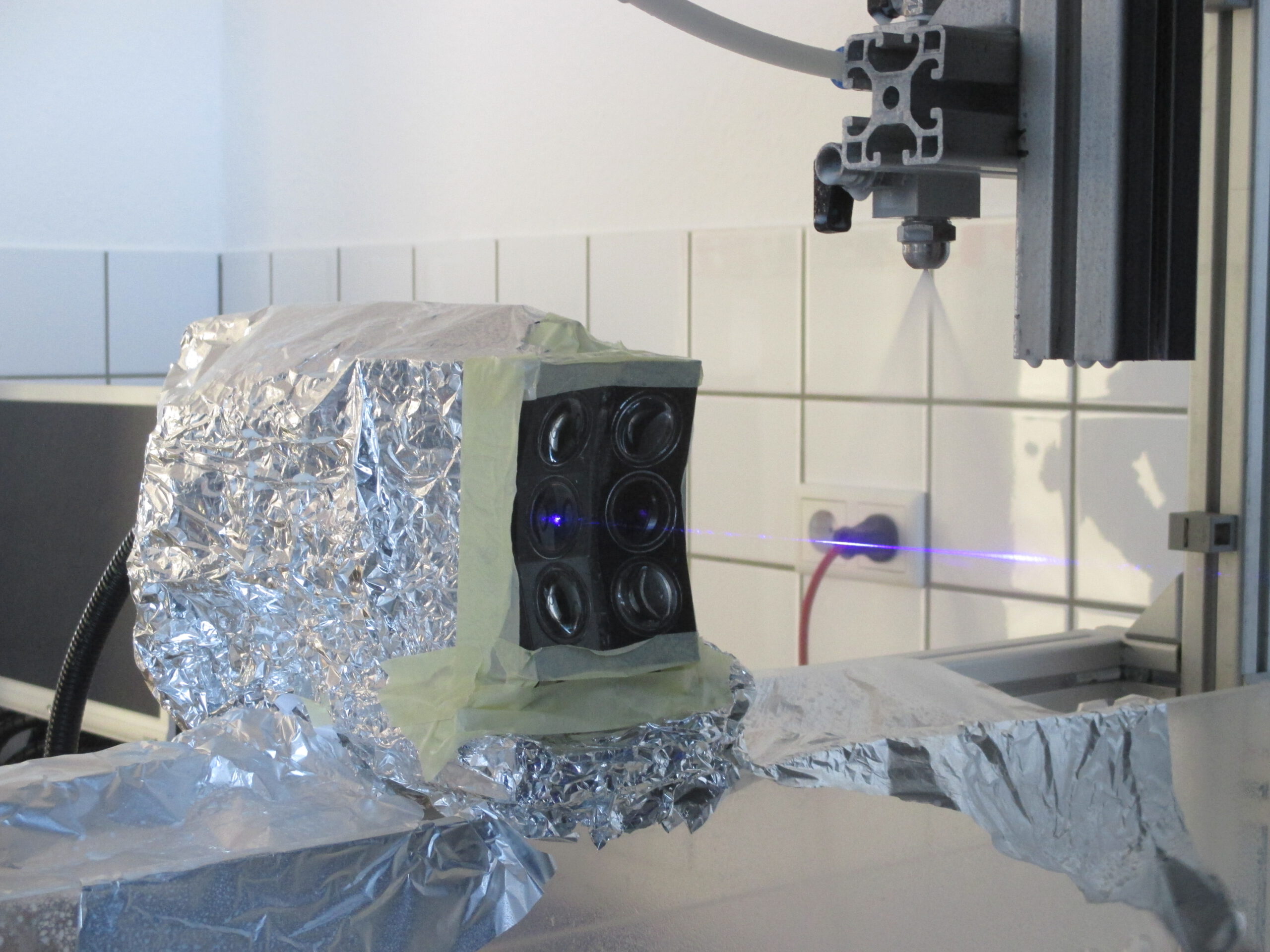
In this study, we conducted an experimental investigation into the fluid dynamics and atomization behavior of milk and milk–water mixtures. The goal was to understand how varying concentrations affect the spray formation process. For these measurements, we employed a Time-Shift Time-of-Flight (TSTOF) instrument — a technology capable of characterizing droplet size and velocity based on time-resolved light scattering signals.
This work dates back to 2016, when the classical TSTOF system was used. Today, we apply significantly more advanced AI-driven instruments such as ParticleTensorAI®, which go beyond basic size and velocity measurements. These modern systems can additionally estimate particle load and internal composition by transforming multichannel scattering signals into image-like tensors analyzed by convolutional neural networks (CNNs).
These advances represent a shift from traditional single-event processing to continuous, trigger-free analysis — enabling high-resolution, real-time monitoring of complex sprays.
Abstract
The characterization of suspension/emulsion sprays plays a decisive role in many industrial processes. A good example of such a process is the drying of a milk spray to produce milk powder, where the process efficiency and product quality is typically controlled by atomization parameters like flow rate, pressure, etc.. However these parameters influence directly the droplet size and droplet velocity distributions in a spray so that optimizing a spray drying process often involves adjusting the spray to a desired droplet size and droplet velocity distribution. This requires a measurement technique capable of characterizing in real time the droplets in a suspension/emulsion spray. To achieve this aim we present developments to the well-known time-shift technique for spray measurements [1][2][3][4]. This technique is based on the light scattering of a single droplet/particle from a shaped light beam and can be operated in backscatter, meaning that the detectors and light sources can be placed on one side of the measurement position, making the technique more attractive for applications with limited optical access. Using the modified time-shift technique [3][5] the milk spray created by different