

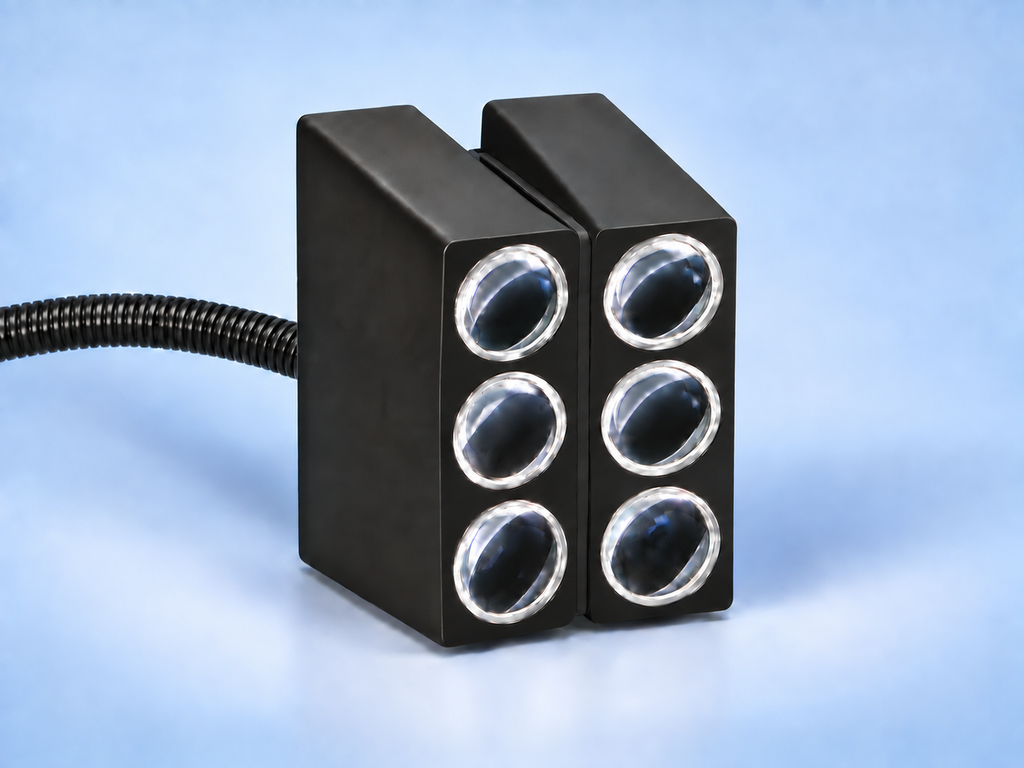
LSS4 is a four-channel optical measurement probe for advanced droplet and particle characterization. It is used with the PTA4 configuration of ParticleTensorAI® and with the classical TSTOF measurement system.
The probe generates time-resolved light-scattering signals from droplets or particles passing through the measurement region. Four optical detector channels provide several independent views of each particle event and enable different evaluation concepts depending on the connected measurement system.
Compatible Systems
LSS4 uses the CLEON control unit for signal acquisition and processing. The same optical probe hardware can support different measurement concepts depending on the firmware and evaluation software.
| System | Control Unit | Evaluation Concept |
|---|---|---|
| PTA4 | CLEON | AI-based ParticleTensorAI® evaluation |
| TSTOF | CLEON | Classical TSTOF evaluation |
Technical Specifications
| Parameter | Specification |
|---|---|
| Measurement principle | Time-resolved light scattering |
| Active detector channels | 4 |
| Available wavelengths | 405 nm, 450 nm |
| Dimensions | Approx. 200 × 150 × 70 mm |
| Compatible control unit | CLEON |
| Compatible systems | PTA4, TSTOF |
Four Detector Channels
The four detector channels provide more than simple signal redundancy. They allow several independent pieces of information to be extracted from the same particle event.
In classical TSTOF evaluation, the four channels provide two independently determined velocity values and four independently determined particle-size values for each individual particle. The differences between these values provide information about the consistency and uncertainty of the individual measurement event. Implausible events can therefore be identified before statistical particle distributions are calculated.
In ParticleTensorAI® operation, the same four time-resolved detector signals are used as input for the AI-based evaluation. Instead of relying exclusively on predefined signal features, ParticleTensorAI® processes the multidimensional signal information to characterize droplets, particles, and material-related properties.
Optical Configuration
The LSS4 probe can be configured for different measurement tasks. Parameters such as wavelength, working distance, optical geometry, and mechanical integration can be adapted to the application. This is particularly important for complex sprays, high particle concentrations, rotary atomizers, and measurements in industrial process environments.
Research configurations based on the LSS4/TSTOF platform may use additional or modified optical arrangements. For example, research presented in 2026 used four detector channels together with two shaped light beams of different polarization. Such configurations demonstrate the flexibility of the measurement platform but should not be interpreted as fixed specifications of every commercial LSS4 probe.
Typical Applications
- Droplet size and velocity measurements
- Advanced spray characterization
- Particle and material characterization with ParticleTensorAI®
- Research on complex and high-concentration sprays
- Measurements with rotary atomizers
- Development of customized optical measurement arrangements
References
- W. Schaefer, L. Li, P. Stegmann, M. Terada. “Technical Report on the TSTOF Measurement Method: Technical Basics, Historical Development, and Comparison with Other Laser-Based Measurement Methods.” Photonics 13(1), 56, 2026. doi:10.3390/photonics13010056 (open access)
- W. Schäfer, T. Jakobs, P. Stegmann. “AI-assisted monitoring of coal particles within droplets in a coal monoethylene glycol slurry spray.” 41st International Symposium on Combustion, Kyoto, 2026. KITopen ID 1000196272. doi:10.5445/IR/1000196272 (open access)