

At ILASS Europe 2025, the 33rd Conference on Liquid Atomization & Spray Systems, held from 31 August to 4 September 2025 in Lund, Sweden, we presented a study on optical droplet measurement in suspension droplets. The work focuses on the analysis of light scattering signals from milk-water droplets in order to determine the concentration of suspended particles inside the droplets.
A milk spray is a good model system for complex suspension droplets. Milk contains small particles and dispersed phases that change the optical behavior of each droplet. Therefore, milk-water mixtures can be used to study how light scattering signals depend on suspension concentration.
Optical Droplet Measurement in Milk Spray
Reliable droplet measurement is important for many spray processes. This includes spray drying, food production, pharmaceutical processes, paint sprays, and particle-loaded liquids. In these applications, droplets often contain suspended particles, emulsions, or other internal structures.
Classical droplet measurement usually focuses on droplet size and velocity. However, complex droplets contain more information. Their light scattering signal can also carry information about concentration, internal structure, and material composition.
In this work, individual suspension droplets were generated with a monodisperse droplet generator. A controlled droplet chain made it possible to study droplets with almost constant size. This allowed a direct comparison of light scattering signals from different milk concentrations.
Light Scattering of Milk-Water Droplets
The study analyzed the light scattering of a colloid droplet on an elliptical Gaussian beam. The measurement was performed in the backscatter region at a fixed scattering angle. A photomultiplier and a high-speed signal analyzer recorded the signals with high time resolution.
The measurements used milk-water mixtures with concentrations from 0% to 100%. For low concentrations, fine concentration steps were used because the optical properties change strongly in this range.
As the milk concentration changes, the shape of the light scattering signal also changes. Low-concentration droplets can still behave partly like transparent droplets. At higher concentrations, internal scattering becomes stronger, and refraction-based signal parts decrease.
AI and Statistical Signal Analysis
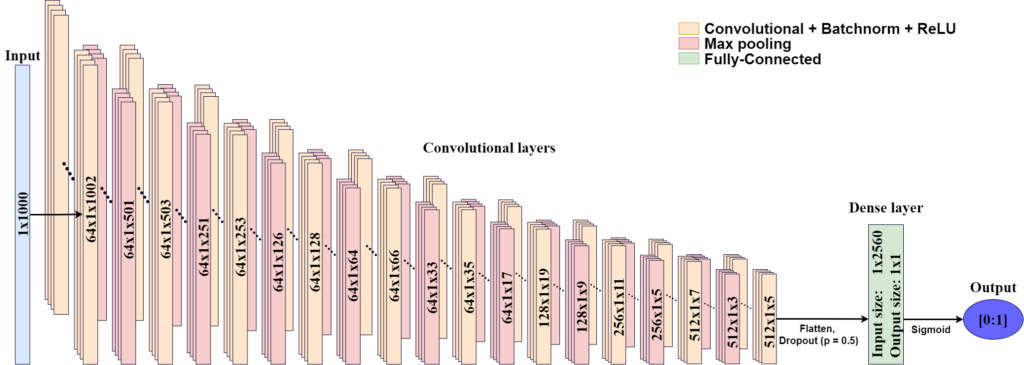
Two methods were used to determine the concentration of the suspension droplets. The first method used an artificial neural network. The second method used statistical properties of the light scattering signal.
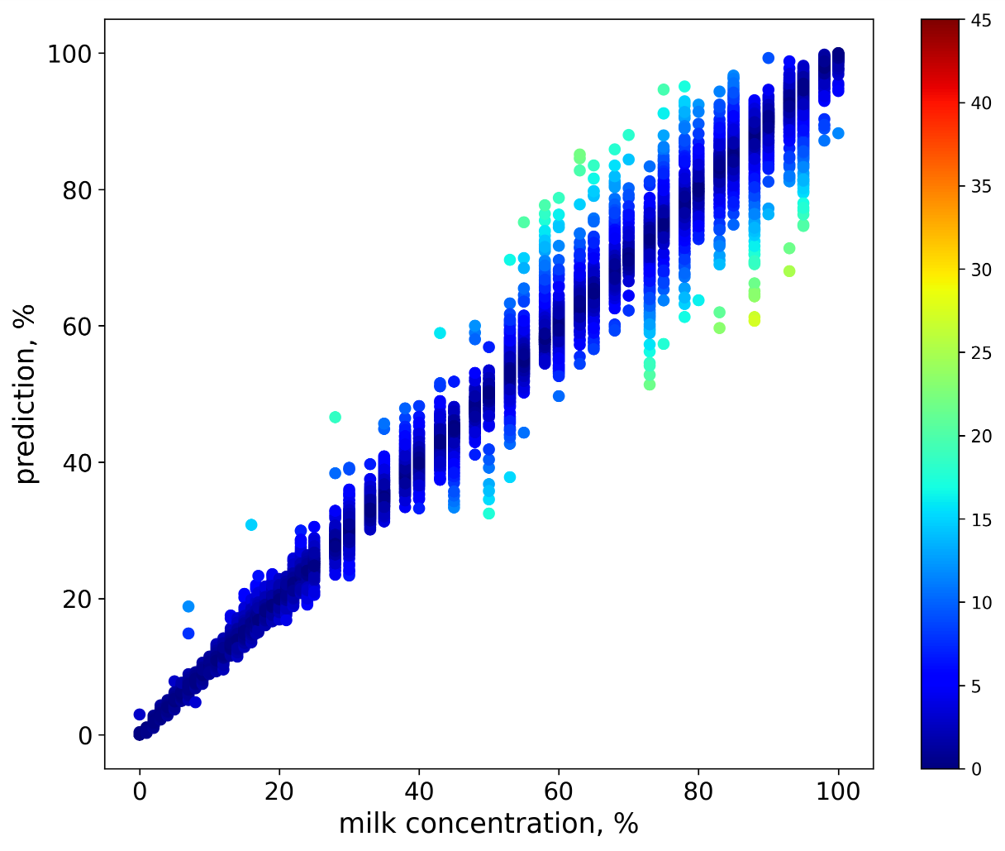
For the AI-based method, individual light scattering signals were extracted from the measured data. The neural network then learned the relationship between signal shape and milk concentration.
In the statistical approach, the signal shape was described by a shape factor. This factor uses the relation between the mean value and the standard deviation of the light scattering signal. The results showed a clear functional relationship between the shape factor and the milk concentration.
Results for Milk Spray and Suspension Droplets
The study showed that light scattering signals from individual droplets can be used to determine suspension concentration. The AI approach predicted milk concentration with good accuracy, especially at lower and medium concentrations.
The statistical approach also showed strong potential. It does not require droplet size or droplet velocity as input. Therefore, it may support simple and robust droplet measurement in complex sprays.
These results are important for future milk spray analysis, suspension spray monitoring, and concentration measurement in particle-loaded droplets.
Relevance for Spray Drying and Process Monitoring
Milk spray analysis is relevant for spray drying and food process engineering. In spray drying, droplet concentration, particle content, and internal structure can influence drying behavior and final powder quality.
The presented method can also support other applications. These include pharmaceutical sprays, coating processes, slurry sprays, emulsions, and other complex liquids.
By combining optical droplet measurement with AI and statistical signal analysis, the work shows a new way to extract material information from dynamic droplets in a spray.
Reference
Doan, A. M. A., Schäfer, W., & Chernoray, V. (2025). Analysis of the light scattering of a colloid droplet on a Gaussian beam to determine the suspension concentration. ILASS Europe 2025, 33rd Conference on Liquid Atomization & Spray Systems, Lund, Sweden, 31 August–4 September 2025.
