

At the DECHEMA/VDI meeting of the Food Process Engineering Group 2026 in Karlsruhe (in German: Jahrestreffen der DECHEMA/VDI-Fachgruppe Lebensmittelverfahrenstechnik 25. – 27. Feb. 2026, Karlsruhe) , we presented a poster on optical characterization of dynamic double-emulsion droplets in a spray. The work focuses on complex droplet measurement and shows how TSTOF-based light scattering signals can provide information about structured droplets, emulsions, and sprays.
https://lvt.blt.kit.edu/2947.php
Complex droplets are important in food technology, coating processes, pharmaceuticals, and multiphase flow research. In contrast to simple liquid droplets, they may contain inner droplets, particles, or different liquid phases. Therefore, their optical signals contain more information than size and velocity alone.
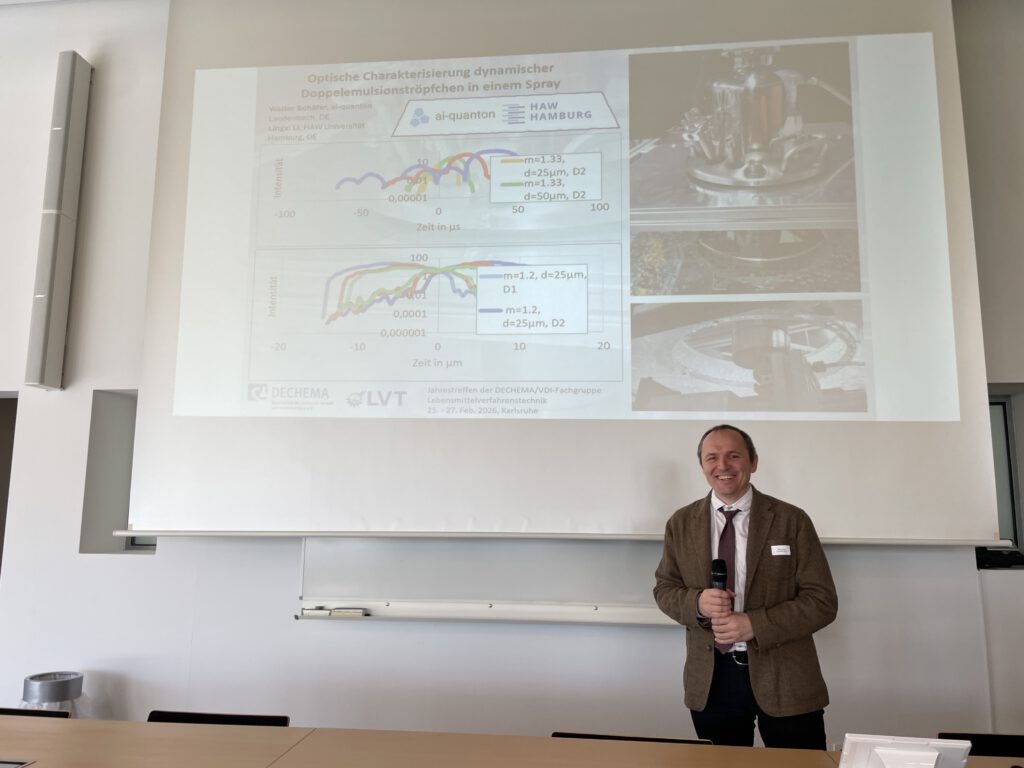
Optical Measurement of Double-Emulsion Droplets
The poster describes a method for measuring individual dynamic double-emulsion droplets. The approach uses light scattering signals recorded by a TSTOF measurement instrument. These signals can contain physical information about the internal structure of complex droplets.
To understand these signals, simulations based on 3D ray tracing are used. The aim is to identify correlations between light scattering patterns and characteristic properties of double-emulsion droplets. Both configurations are considered: water droplets containing an inner oil droplet and oil droplets containing an inner water droplet.
From Double Emulsions to Milk Spray Characterization
The same concept is relevant for milk spray characterization, because milk is a complex multiphase liquid. It contains water, fat droplets, proteins, and other components. When milk is atomized into a spray, each droplet can carry information about composition, structure, and process conditions.
Optical measurement methods can help analyze this behavior. By evaluating light scattering signals from individual droplets, researchers can study droplet families, material differences, and changes in the spray. This creates new possibilities for monitoring food-related sprays and other complex liquids.
TSTOF and AI-Assisted Signal Analysis
TSTOF technology measures time-resolved light scattering signals from individual droplets. In classical applications, this method can determine droplet size and velocity. However, complex droplets require a deeper analysis.
For this reason, artificial intelligence can support the evaluation of complex light scattering signals. In the presented work, double-emulsion sprays are generated and their signals are clustered with AI. This helps identify possible droplet families and supports the analysis of complex spray systems.
Experimental Validation
For experimental validation, clear-coat-coated glass beads are used in a drop tower. These particles simulate the dynamics of individual droplets and allow controlled optical experiments. In further investigations, double-emulsion sprays are generated and analyzed under spray conditions.
This combination of simulation, experiment, TSTOF diagnostics, and AI-assisted clustering provides a strong basis for complex droplet measurement. It also supports future applications in milk spray characterization, food process monitoring, material analysis, and industrial spray diagnostics.
Application Potential
Complex droplet measurement can support the analytical investigation and monitoring of mixing processes. It can also help characterize emulsions, suspensions, food sprays, pharmaceutical sprays, coating materials, and other multiphase systems.
For milk spray characterization, the method offers a path toward a deeper understanding of atomized dairy liquids. It can help analyze droplet structure, spray stability, process changes, and material-related spray behavior.
The presented approach shows how optical spray diagnostics can move beyond simple droplet sizing. It opens new possibilities for analyzing the internal structure of complex droplets in real time.
References
[1] Schaefer, W., Fleck, S., Haas, M., & Jakobs, T. (2025). Optical Measurement Method for Monitoring High-Mass-Concentration Slurry Sprays: An Experimental Study. Photonics, 12(7), 673. https://doi.org/10.3390/photonics12070673
[2] Schaefer, W.; Li, L.; Stegmann, P.; Terada, M. Technical Report on the TSTOF Measurement Method: Technical Basics, Historical Development, and Comparison with Other Laser-Based Measurement Methods. Photonics 2026, 13, 56. https://doi.org/10.3390/photonics12070673
[3] Li, Lingxi, et al. “Simulation of Light Scattering from a Colloidal Droplet Using a Polarized Monte Carlo Method: Application to the Time-Shift Technique.” Optics Express, vol. 27, no. 25, Dec. 2019, p. 36388, https://doi.org/10.1364/oe.27.036388
