

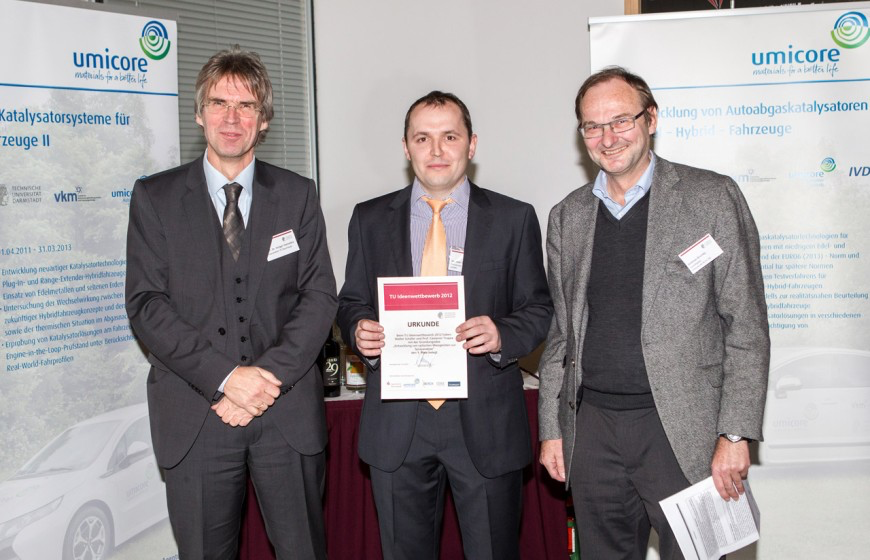
In 2012, Walter Schäfer won first place in the Ideas Competition of the Technical University of Darmstadt with an optical measurement instrument for analyzing droplets and particles in flows.
The award-winning concept originated from his doctoral research at the Department of Fluid Mechanics and Aerodynamics at TU Darmstadt. It introduced a compact optical approach for measuring complex droplets, including emulsions, suspensions, and non-transparent spray droplets. The project ranked first among 81 submitted business and research ideas.
About the TU Darmstadt Ideas Competition
The TU Darmstadt Ideas Competition encouraged students, graduates, and researchers to present innovative research results and business concepts to a jury of experts.
TU Darmstadt had organized the competition annually since 2007. Its main objective was to identify research with commercial potential, support technology transfer, and strengthen the entrepreneurial culture at the university and throughout the Darmstadt region.
Participation grew strongly in 2012. The competition received 81 submissions, almost three times as many as in the previous year. Therefore, the first-place award placed the optical droplet analyzer ahead of 80 other ideas from different scientific and technical fields.
The Winning Idea: An Optical Droplet Analyzer
The winning project focused on the optical characterization of individual droplets and particles in a flow.
Droplet and particle properties play an important role in many industrial processes. Their size, velocity, transparency, and composition can influence the stability and quality of spraying, coating, drying, combustion, and particle-production processes.
However, many established optical measurement systems work best with transparent and nearly spherical droplets. They may provide less reliable results when droplets contain pigments, suspended particles, emulsified materials, or other internal structures.
Walter Schäfer’s research addressed this limitation. The proposed instrument extended existing optical methods so that they could also measure non-transparent particles and droplets from suspensions and emulsions with relatively low equipment requirements.
Why Are Complex Droplets Difficult to Measure?
A transparent and homogeneous droplet often produces a clearly defined light-scattering signal. In contrast, complex droplets may contain:
- solid particles,
- pigments,
- different liquid phases,
- air inclusions,
- crystals,
- biological material,
- strongly absorbing components.
These internal structures can change the intensity and shape of the scattered light. As a result, conventional evaluation methods may fail to identify the relevant signal features.
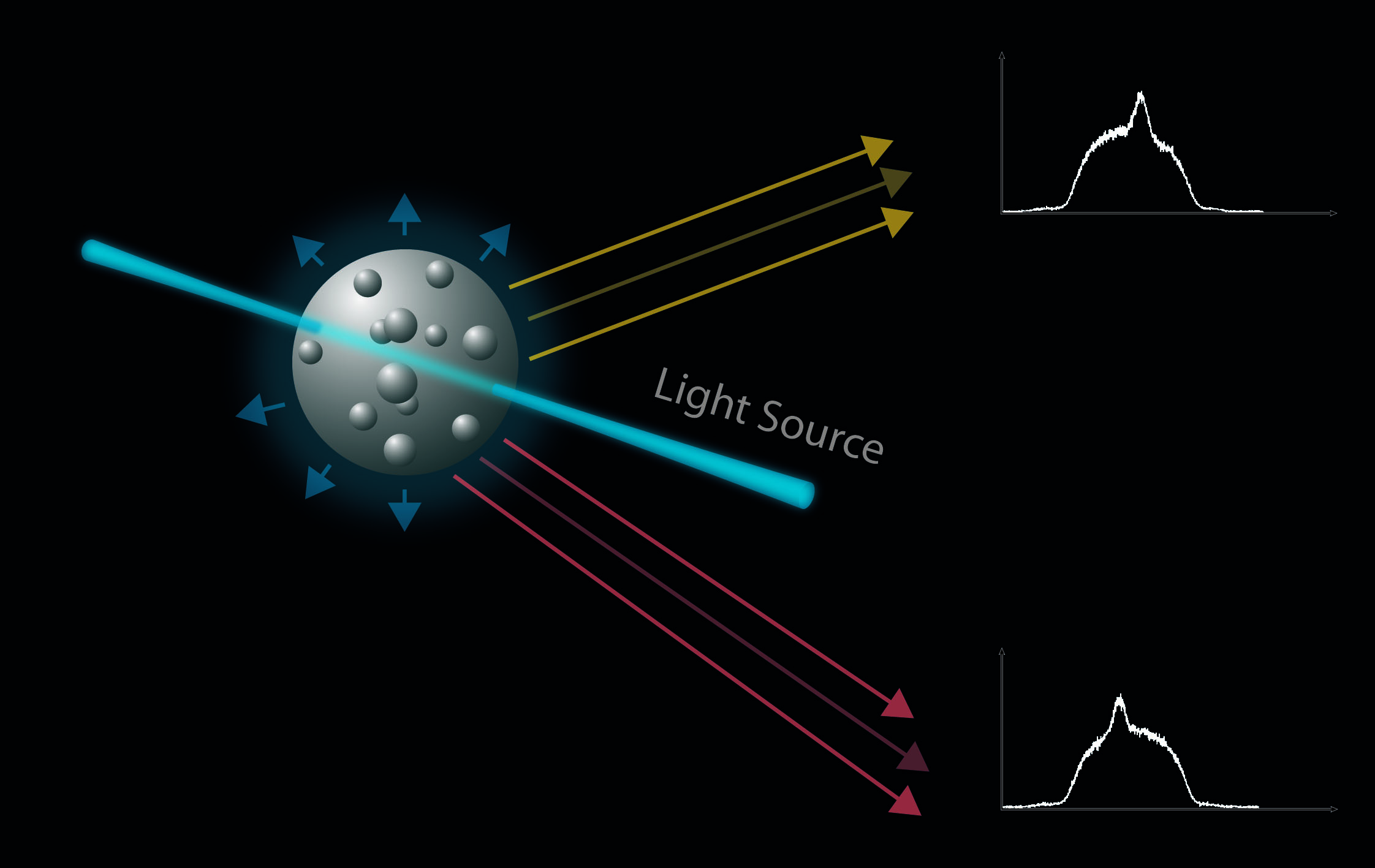
The award-winning concept addressed this challenge by recording and analyzing the time-resolved light-scattering signatures generated by individual droplets or particles.
The Role of Time-Resolved Light Scattering
When a droplet passes through a shaped laser beam, it scatters light toward one or more optical detectors. The detectors record how the light intensity changes during the passage of the droplet.
Instead of using only one intensity value, the measurement system analyzes the complete temporal signal. Depending on the optical arrangement, this signal can contain information about:
- droplet size,
- droplet velocity,
- optical transparency,
- internal composition,
- particle concentration,
- signal symmetry,
- characteristic scattering modes.
This detailed signal information creates a basis for both physical evaluation methods and later statistical or AI-assisted analysis.
Connection to TSTOF Measurement Technology
The research presented at the competition formed part of the early development of the Time-Shift-Time-of-Flight technique, abbreviated as TSTOF.
Walter Schäfer developed the first prototypes during his doctoral research between 2008 and 2012 together with Prof. Cameron Tropea at TU Darmstadt. The first operational prototypes were also presented publicly in 2012.
TSTOF uses time-resolved optical scattering signals to characterize individual droplets or particles. The method combines information about the temporal position, shape, and sequence of signal peaks.
Consequently, the instrument can extract more information than optical systems that measure only the average intensity of an entire spray.
Applications in Freeze-Drying and Coating Processes
According to TU Darmstadt, the measurement approach offered potential for both freeze-drying applications and industrial coating processes.
In coating technology, droplet size and velocity affect:
- spray transfer,
- surface coverage,
- coating uniformity,
- overspray,
- film formation,
- material consumption.
Moreover, paints often contain pigments and other solid components. Therefore, paint droplets can be difficult to analyze with measurement methods designed mainly for transparent liquids.
In drying and particle-production processes, droplet properties also influence evaporation, heat transfer, particle formation, and the properties of the final product.
A Compact Measurement Approach
Another important aspect of the project was its relatively low equipment requirement.
Industrial users often need compact instruments that fit into existing test rigs or production systems. Large optical systems may require access from several sides, sensitive alignment, or substantial installation space.
The winning concept aimed to reduce this complexity while preserving access to information from individual droplets. This combination of detailed measurement and practical system design contributed to the project’s commercial potential.
Supporters of the 2012 Competition
Several industrial and regional organizations financially supported the competition:
- Umicore AG,
- Sparkasse Darmstadt,
- ISRA VISION,
- Merck KGaA,
- Software AG.
Their involvement highlighted the importance of cooperation between universities, technology companies, investors, and regional institutions when transferring research into practical applications.
Development After the Competition
In 2013, ai-quanton was founded as a spin-off from TU Darmstadt. The company continued the development of optical instruments and analysis methods based on TSTOF measurement technology.
The 2012 competition entry did not yet represent today’s AI platforms in their current form. Instead, it introduced the optical and signal-processing foundation from which later product and technology developments emerged.
These later developments include:
- SpraySpy, a brand name for established TSTOF-based measurement instruments,
- SprayQuantAI, an AI-assisted counting and droplet-analysis approach,
- ParticleTensorAI, a tensor-based method for evaluating buffered light-scattering signals.
These names describe later commercial or technological developments. The underlying physical measurement process remains the optical detection and analysis of time-resolved light-scattering signals.
Importance of the First-Place Award
The TU Darmstadt Ideas Competition marked an important transition from doctoral research to an industrial technology concept.
The award recognized several central aspects of the project:
- its scientific foundation,
- its relevance to industrial processes,
- its ability to analyze complex droplets,
- its compact measurement approach,
- its potential for commercialization,
- its contribution to university technology transfer.
Therefore, the first-place result became an early milestone in the development of optical spray measurement technology at ai-quanton.
