

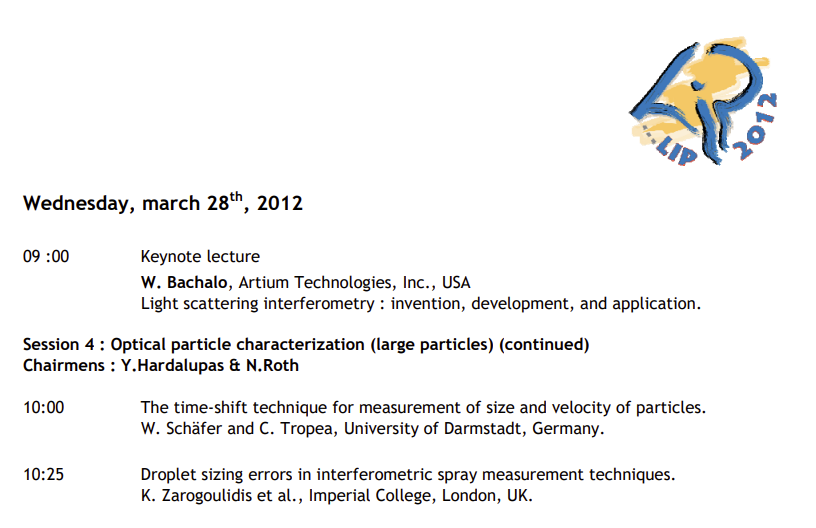
From 26 to 30 March 2012, the ninth international conference on Lasers and Interactions with Particles, known as LIP 2012, took place at INSA de Rouen and CORIA in Rouen, France. On 28 March 2012, Walter Schäfer presented the contribution “The Time-Shift Technique for the Measurement of Particle Size and Velocity.” The research was carried out together with Prof. Cameron Tropea at the Technical University of Darmstadt.
https://www.sla.tu-darmstadt.de/sla/index.de.jsp
The presentation introduced an optical measurement approach for determining the size and velocity of individual droplets in technically challenging sprays. The experiments focused on milk droplets as a natural emulsion and pigmented paint droplets as a complex industrial spray medium.
An Early Presentation of TSTOF Measurement Technology
The contribution presented in Rouen marked an important stage in the development of the Time-Shift Time-of-Flight measurement method, abbreviated as TSTOF.
A later technical review identifies 2012 as the year in which Walter Schäfer and Cameron Tropea presented the first operational measuring instrument based on TSTOF technology at the Technical University of Darmstadt. The development formed part of several research projects and doctoral studies in optical particle and spray diagnostics.
The LIP 2012 presentation demonstrated how time-resolved light-scattering signals can determine two essential properties of a moving droplet:
- droplet diameter,
- droplet velocity.
The method detects droplets individually. Therefore, it can provide size and velocity distributions instead of only averaged information about the complete spray.
Why Measure Individual Droplets?
Droplet size and velocity strongly influence the behavior of a spray. They affect processes such as:
- atomization,
- coating quality,
- spray drying,
- evaporation,
- combustion,
- heat and mass transfer,
- pharmaceutical spray delivery,
- material deposition.
However, complex liquids can create difficulties for conventional optical measurement systems. Transparent water droplets produce relatively well-defined scattering patterns. In contrast, emulsions, suspensions, and pigmented paints may absorb light or scatter it internally.
As a result, signals from complex droplets can become distorted, weak, or difficult to interpret. The LIP 2012 study investigated whether the time-shift approach could still extract useful size and velocity information under these challenging optical conditions.
How Does the Time-Shift Technique Work?
A droplet passes through a shaped laser beam with a defined spatial intensity distribution. As the droplet moves through the beam, it scatters light toward optical detectors.
Because different optical scattering modes originate from different positions within or on the surface of the droplet, the detector records a time-resolved signal with several characteristic peaks. The temporal distance between these peaks depends on the droplet diameter and velocity.
TSTOF combines two forms of information:
Time shift:
The temporal displacement between characteristic scattering peaks contains information about the droplet size.
Time of flight:
The passage of the droplet through spatially separated light regions provides information about its velocity.
The method therefore converts the spatial interaction between a droplet and the laser beam into a temporal light-scattering signature. The signal shape also contains additional information about the optical properties and composition of the droplet.
Compact Near-Backscatter Configuration
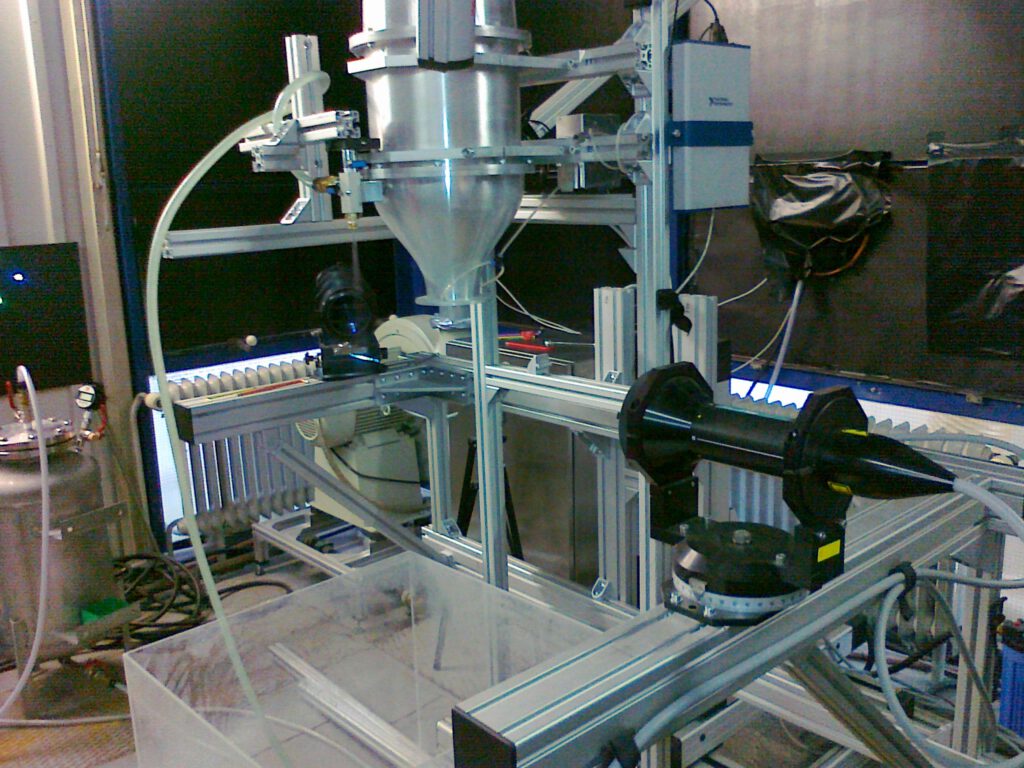
The LIP 2012 experiments used a near-backscatter configuration with two optical detectors. In this arrangement, the illumination and detection components can operate from approximately the same side of the spray.
This configuration offers practical advantages. It can reduce the need for optical access on opposite sides of a measurement chamber. Consequently, the method may be suitable for test rigs, enclosed spray systems, wind tunnels, coating installations, and other environments with limited access.
Moreover, the compact optical arrangement can simplify alignment compared with measurement techniques that require a large receiving system on the opposite side of the spray.
Measurements of Milk Droplets
Milk served as a natural example of an emulsion. A milk droplet contains water, fat, proteins, and other components. These constituents create internal scattering and make the optical response more complex than that of a pure water droplet.
Despite this complexity, the TSTOF system recorded recognizable time-shift signatures. The signals contained peaks associated with surface reflection and refracted light.
The experiments showed that the measurement principle could still identify the relevant optical signal components. Therefore, the system could estimate both droplet diameter and velocity for milk sprays.
This result demonstrated that TSTOF was not limited to optically ideal, fully transparent liquids. It also showed potential for emulsions and other heterogeneous droplet systems.
Measurements of Pigmented Paint Droplets
Pigmented paint sprays present an even greater optical challenge. Pigments and dispersed particles absorb and scatter light inside the droplets. Consequently, the recorded signals may contain secondary peaks, changing amplitudes, or distorted signal shapes.
The study showed that the system could still detect and process many of these signals. A less restrictive validation criterion allowed the evaluation to retain useful droplet events even when their signatures did not match an ideal transparent-droplet signal.
Although individual signals could contain greater uncertainty, the measurement still produced meaningful statistical information for the droplet ensemble.
This finding was important for industrial coating applications, where real paint droplets often differ significantly from ideal transparent and homogeneous droplets.
Main Findings of the LIP 2012 Contribution
The experiments demonstrated several important capabilities of the time-shift approach:
- simultaneous measurement of individual droplet size and velocity,
- operation with complex and optically heterogeneous liquids,
- detection of characteristic light-scattering modes,
- measurement in a compact near-backscatter arrangement,
- evaluation of signals under reduced signal-to-noise conditions,
- generation of statistically useful results for pigmented paint sprays.
The results indicated that time-resolved light-scattering signatures contain more information than a single intensity value. Their shape, peak positions, widths, and temporal sequence can support a detailed analysis of individual droplets.
Connection Between Research and Industrial Spray Measurement
The presentation at LIP 2012 was part of the transition from fundamental university research toward practical optical spray measurement technology.
Milk and paint represented two important classes of complex droplets:
- emulsions with internal structures,
- industrial liquids containing pigments and dispersed materials.
Both examples showed that optical measurement methods must handle real material properties rather than only ideal transparent droplets.
Today, the analysis of time-resolved light-scattering signals remains relevant for coating technology, spray drying, pharmaceutical sprays, combustion research, suspension sprays, and industrial process monitoring.
Historical Importance of the Conference Contribution
The LIP 2012 contribution took place during the final phase of Walter Schäfer’s doctoral research at the Technical University of Darmstadt. It presented an operational TSTOF measurement concept to an international community specializing in laser–particle interaction and optical particle characterization.
The conference was particularly suitable for this work because it connected:
- theoretical descriptions of light scattering,
- optical system development,
- particle-sizing techniques,
- laser diagnostics,
- industrial measurement applications.
Therefore, the presentation did not only report experimental results. It also introduced a measurement architecture that later supported continued research into transparent, semi-transparent, and heterogeneous droplets.
