


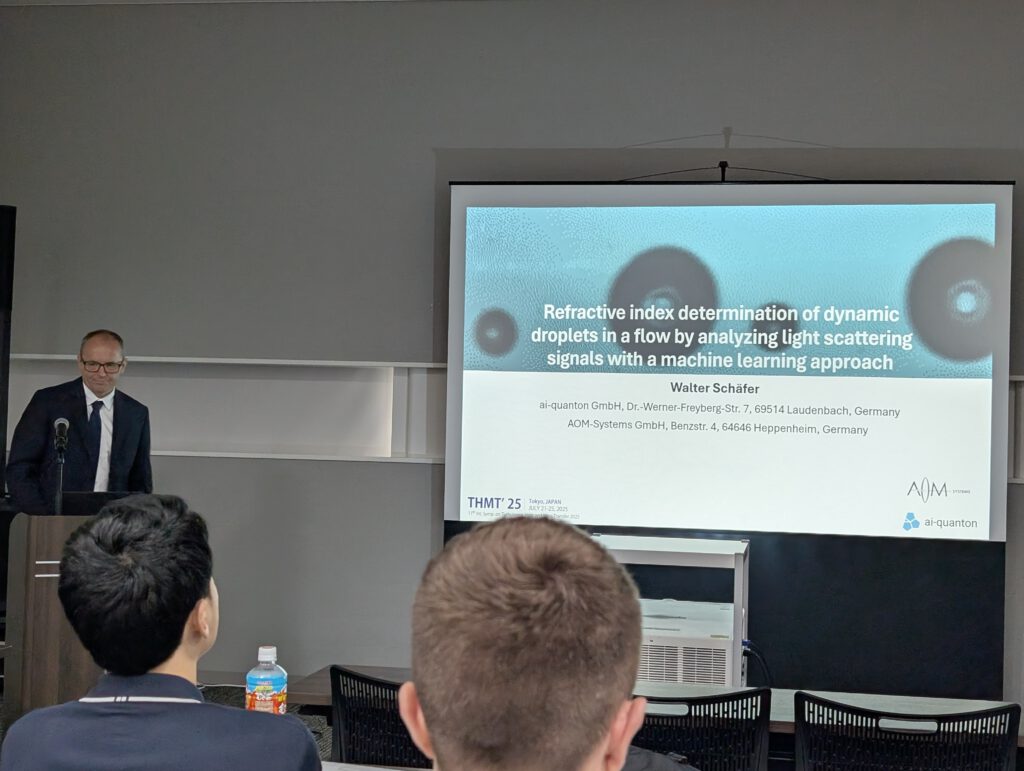
At THMT 2025 – the 11th International Symposium on Turbulence, Heat and Mass Transfer, held in Tokyo, Japan, from 21 to 25 July 2025, Walter Schäfer presented the work “Refractive Index Determination of Dynamic Droplets in a Flow by Analyzing Light Scattering Signals with a Machine Learning Approach.” This research has potential applications in a variety of fields, including the study of nasal spray dynamics.
https://www.thmt-25.org/index.html
The presentation showed a new method for optical spray measurement of dynamic droplets. The method combines time-resolved light scattering signals with machine learning. As a result, it can support material-sensitive droplet analysis in sprays, including applications such as nasal spray, pharmaceutical sprays, and other fine liquid sprays.
Spray Measurement for Dynamic Droplets
Reliable spray measurement is important for many technical and pharmaceutical applications. In a nasal spray, droplet size, velocity, and liquid properties can influence spray behavior, deposition, and product performance.
Classical optical spray measurement often focuses on droplet size and velocity. However, material properties can also be important. The refractive index of a droplet can provide information about liquid composition, mixing ratio, and concentration.
Therefore, the presented method adds another layer to spray analysis. It uses the optical signal structure of individual droplets to estimate the refractive index.
Experimental Spray Setup
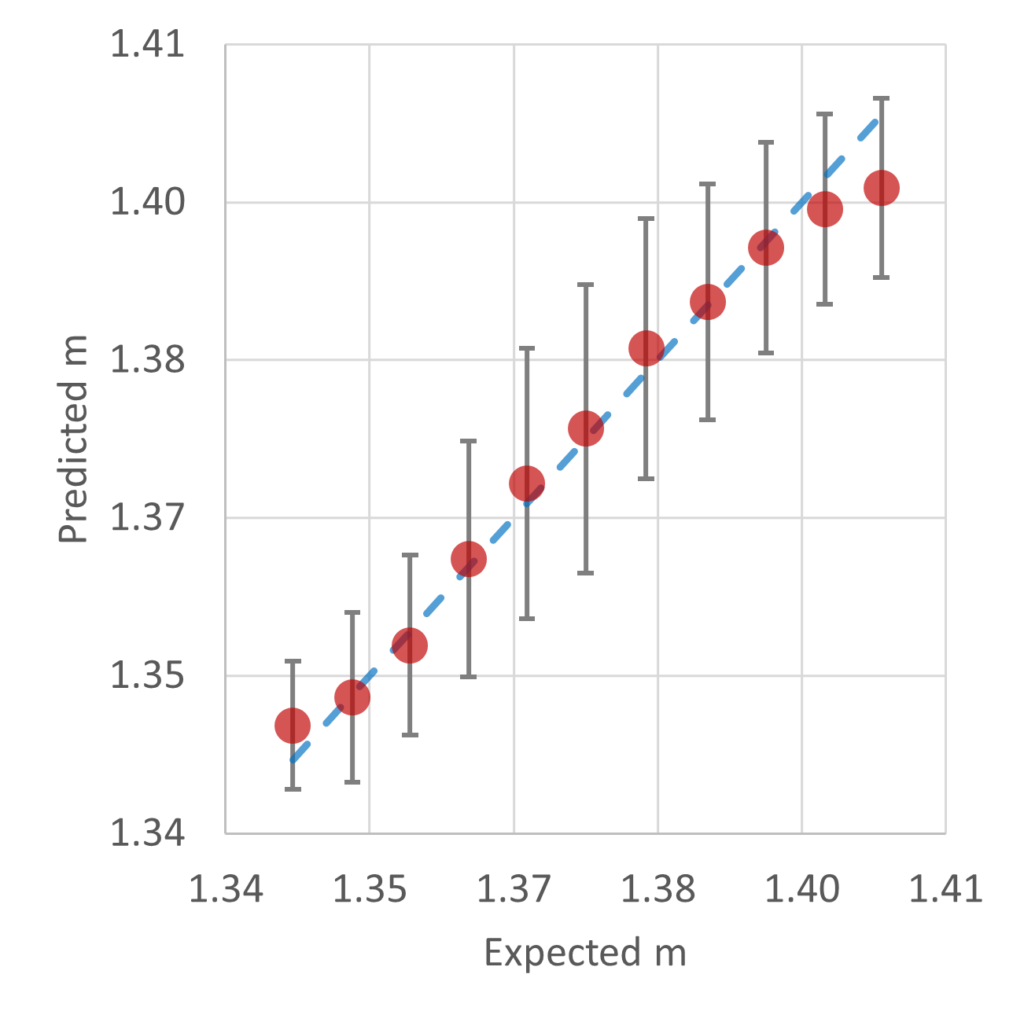
The spray was produced with a flat fan nozzle. Water-glycerin mixtures with different mixing ratios were used to vary the refractive index of the droplets. This controlled setup made it possible to generate droplets with known material differences.
Relevance for Nasal Spray and Pharmaceutical Sprays
Nasal spray products require stable and repeatable spray behavior. Therefore, spray measurement can support product development, quality control, and formulation testing.
Droplet size and velocity are important. However, the optical properties of the droplets can also help characterize liquid composition. For this reason, refractive index determination can provide useful information for nasal spray analysis and other pharmaceutical spray applications.
The presented method shows how optical spray measurement can go beyond classical size and velocity analysis. It can help detect material changes in dynamic droplets and support AI-assisted spray diagnostics.
Outlook
The work presented at THMT 2025 shows how machine learning and light scattering signals can be combined for advanced spray measurement. It demonstrates a path toward compact and intelligent systems for droplet analysis.
In the future, this approach may support nasal spray characterization, pharmaceutical spray testing, coating technology, fuel spray analysis, and industrial process monitoring.
Reference
Schaefer, W. (2025). Refractive index determination of dynamic droplets in a flow by analyzing light scattering signals with a machine learning approach. In Proceedings of THMT-25 Turbulence, Heat and Mass Transfer 11, Tokyo, Japan, 21–25 July 2025. Begell House, p. 8. https://doi.org/10.1615/THMT-25.10
